From a letter in London to a confidential conversation in Jerusalem. The records bring us closer to the questions, choices and daily work of a diplomat.
The story in brief
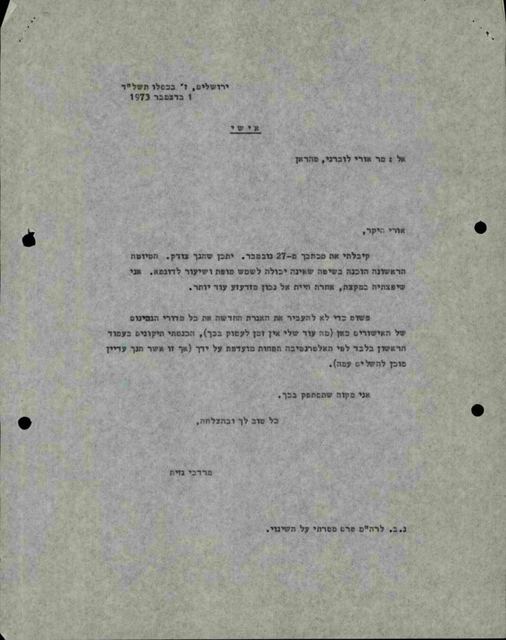
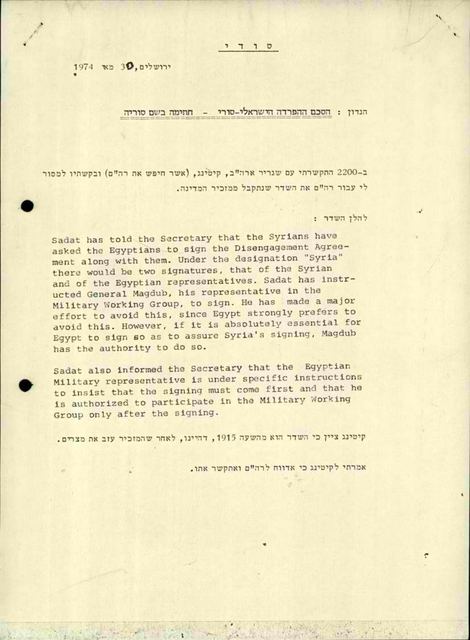
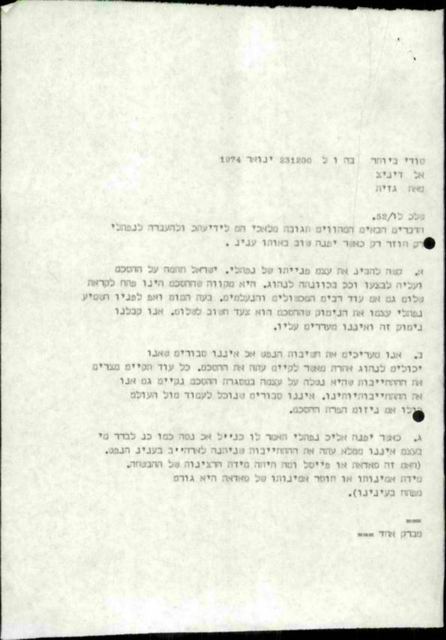
The Israel State Archives preserve letters Gazit sent, cables addressed to him, drafts he worked on and material collected in his office. They include a secret letter from London in 1954, the Yom Kippur War cables and the work of the team he led towards the 1975 interim agreement with Egypt.
The reading room: files read from first page to last
The family downloads full scans of his files and documents from the State Archives. Each one is read here from the first page to the last, and every quotation is checked against the scanned page. A file that adds something real about him gets a page of its own: the background in brief, page-cited findings, scans where reproduced, what the file does not hold, and a link to the Archives. Not every paper that bears his name is brought here: only what shows another side of him, or another thing he did.
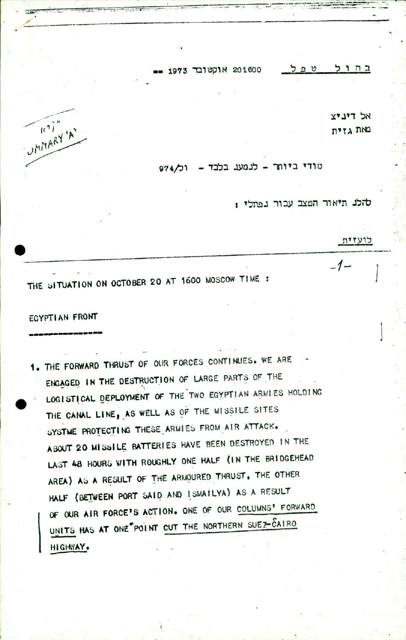
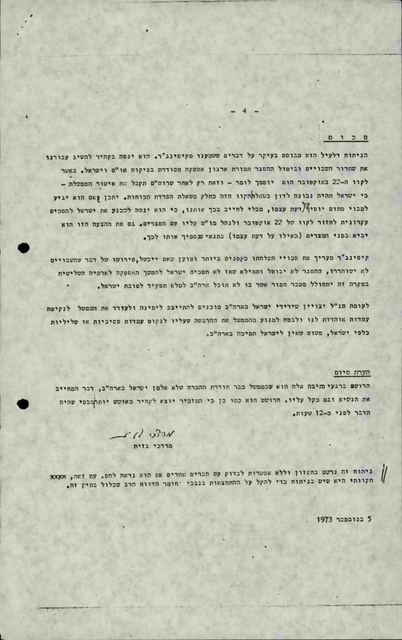
After the war Gazit went back to the cables and set down, summary by summary, what had passed between Israel and the United States in its three weeks. The State Archives published the summaries as an appendix of their own.
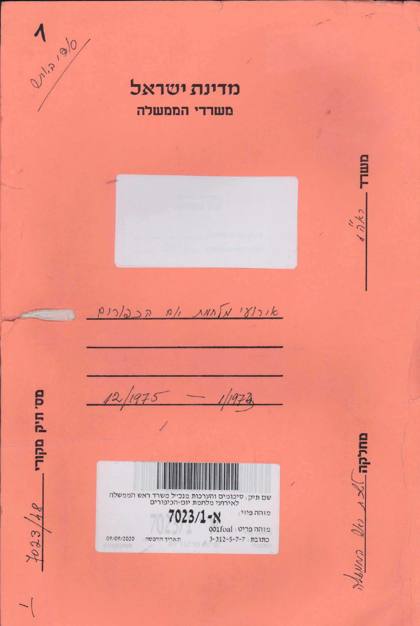
Read in full, with next to nothing of his own6 reference files · 362 pages
Files that carry his name in the Archives’ catalogue but are reference files: papers that reached him or were collected in his bureau. They were read to the end in order to know this, and they have no page of their own. A file gets a page here only when it adds something real: another side of him, another thing he did or wrote.
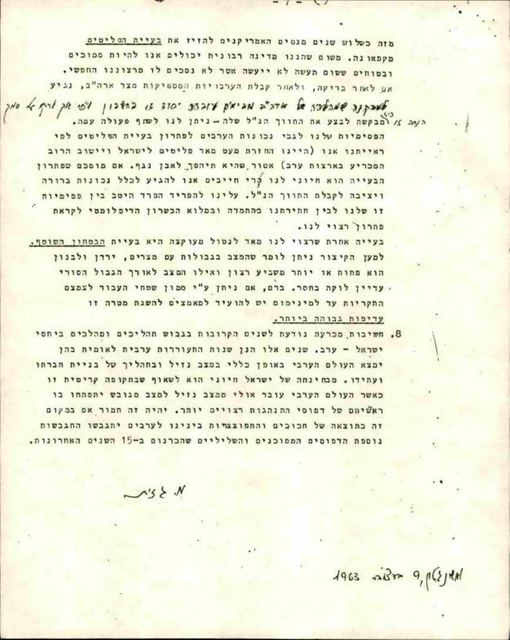
A reference file of texts: the armistice agreements of 1949, a UN report of August 1963 and two printed maps of Jerusalem. It holds no letter or memorandum, and nothing he wrote.
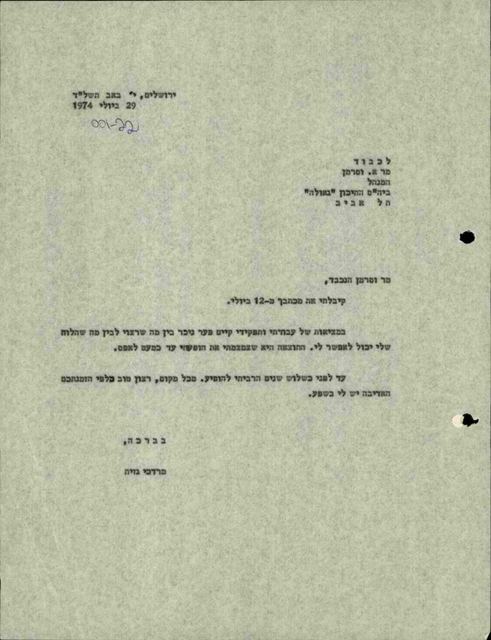
Embassy reports of July 1966 on an Egyptian idea for an oil pipeline alongside the Suez Canal, and an exchange of February 1967 with the Ambassador in Canberra. The papers were sent to him, as a Deputy Director-General of the Foreign Ministry; of his own the file holds a two-line letter of thanks.
A reference file: the texts of the American plans from 1968 to 1970, and the Washington embassy’s cables of late 1968. Only one text carries his name: a three-page summary, of January 1975, of the cables on Secretary of State Dean Rusk’s “seven points”. It holds no assessment of his own.
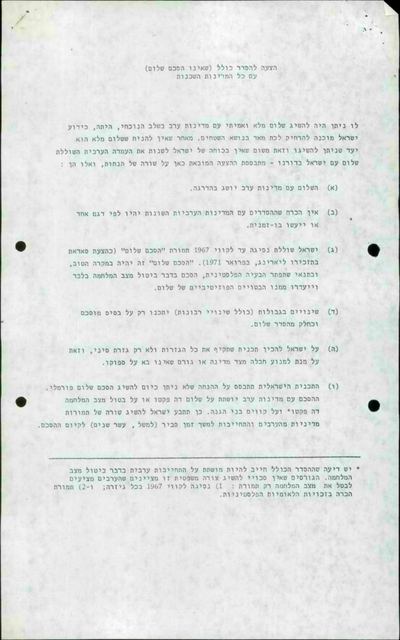
A reference file on the mission of the four presidents on behalf of the Organisation of African Unity: the mission’s memorandum to Sadat and Golda Meir, Israel’s reply of 28 November 1971, a cable from Dakar and an unsigned paper on the Prime Minister’s words. His name appears only in the file’s catalogue title.
A reference file of the Director-General’s bureau, continued under his successor, Amos Eran: public statements, copies of cables, UN and American texts and unsigned chronologies. One cable is addressed to him. It holds no text, signature or note of his.
Hebrew renderings of interviews the Syrian Foreign Minister gave to the press after the interim agreement between Israel and Egypt. They were collected in his bureau. His name appears only on the cover.
By date: document by document
The findings of all the files in one line, oldest first. Each row opens the finding on its file’s page.
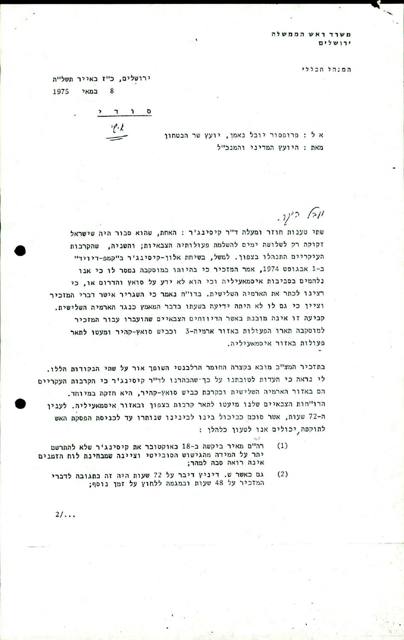
For the war’s fiftieth anniversary the State Archives opened hundreds of files, and many come from Gazit’s own office: meetings he recorded, his cables with Dinitz and with Moscow’s envoy, and the papers of the team he led towards the interim agreement. Most can be read online as scans. Most of these have not yet been read in full for this site; the descriptions follow the Archives’ own.
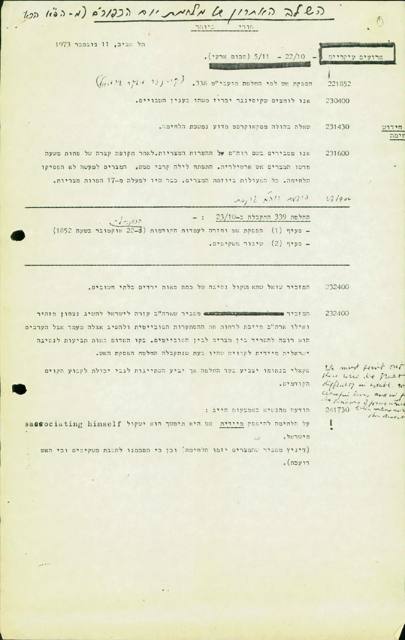
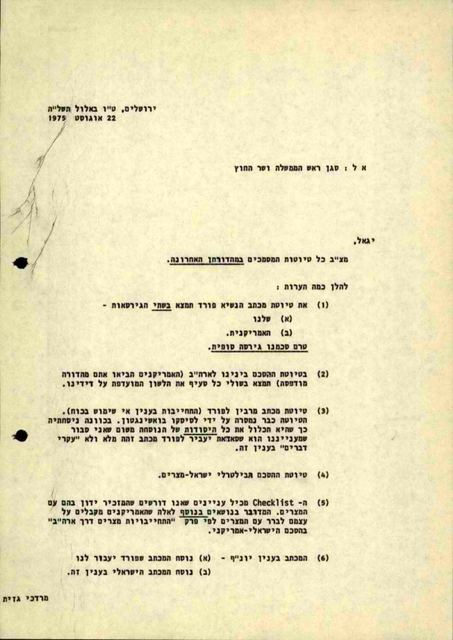
66 pages: his cables to Shalev and Dinitz from the first night, the situation summaries, the tank arithmetic of 15 October, and his 23 October message on the gains on the ground. Scanned and open via NYU.
A secret working paper by a team headed by Zvi Terlo on the holy places and religious bodies in Jerusalem, Judea and Samaria: Jews, Muslims and Christians, the status quo and the communities’ positions.
Israel State Archives · a list prepared for the family
745 files in which his name appears
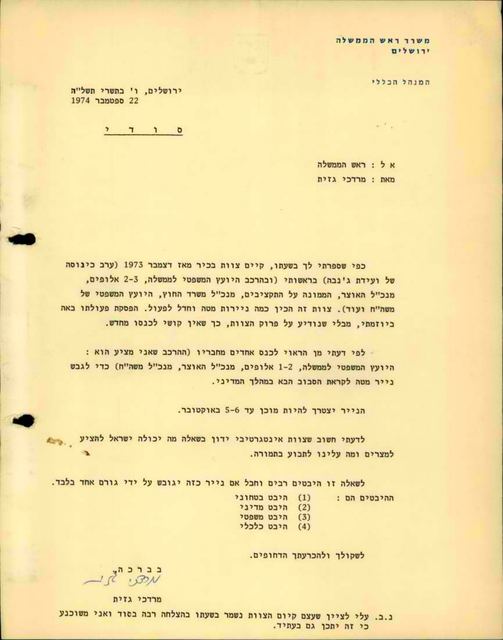
At the family’s request the State Archives compiled a list of every file in which Mordechai Gazit is mentioned. In 406 of them his name is already in the file’s title: most of these are the files of the offices he headed, at the Foreign Ministry and at the Prime Minister’s Office, some shared with his successors. The list shows how wide the work was. Beside the cables of the war and the drafts of the agreements with Egypt and Syria there are files on oil, on the Druze and Circassian communities, on the holy places, and even on daylight saving time.
files in the list
745
carry his name in the title
406
fully open to read
362
partly open
360
Files by the year their material begins
To 195927
1960–196441
1965–196943
1970–1974503
1975–1979107
1980 on24
5 leads from the list
These rest on the Archives’ catalogue descriptions. The files themselves have not yet been read for this site.
The reports from Washington
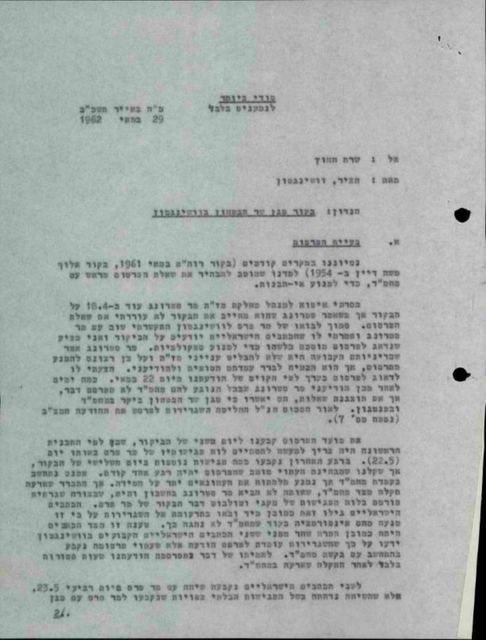
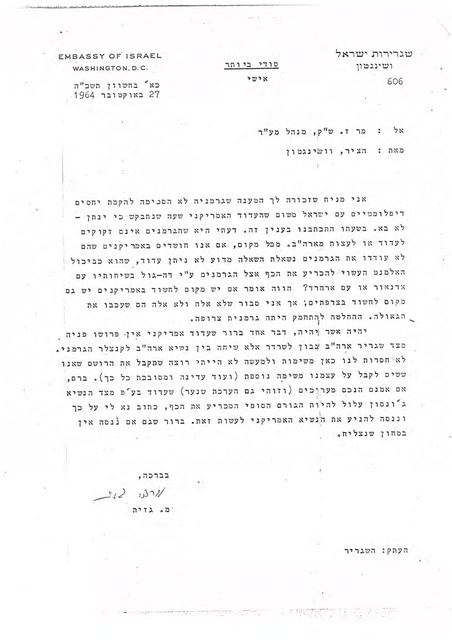
Twenty Foreign Ministry files gather his reports and cables as Minister at the Washington embassy, from 1960 to 1965. Another holds his reports on the visit of Deputy Defence Minister Shimon Peres to Washington in May 1962.
The Deputy Director-General’s files
Thirteen files are headed “Mordechai Gazit, Deputy Director-General”. Their subjects: water, refugees, navigation, Egypt’s economy, the Suez Canal, the armistice agreements and Mount Scopus, and the population census (1967–1968).
14 June 1967
A file from Prime Minister Levi Eshkol’s office, dated to that day, holds according to the catalogue “a document by Mordechai Gazit on the organisational structure for overall planning regarding the territories captured in the Six-Day War” (site translation).
The study of the “Jordanian option”
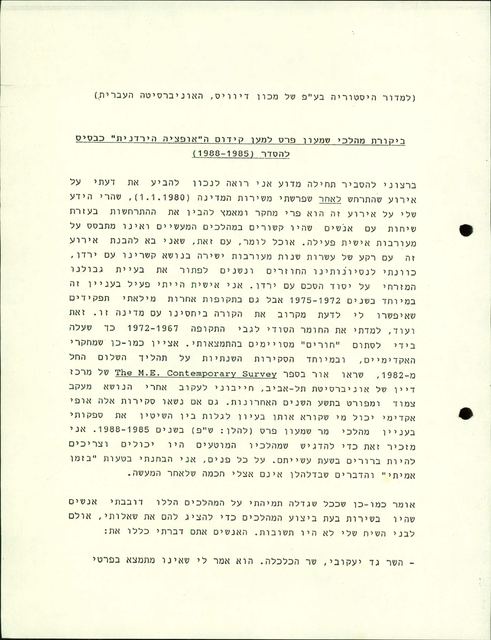
A Davis Institute file from 1987–1990 holds, according to the catalogue, a review by Gazit following research he did on Foreign Minister Shimon Peres’s moves to advance the “Jordanian option” in 1985–1988, among them the understandings between Peres and Hussein.
Paris: a conversation and a photograph
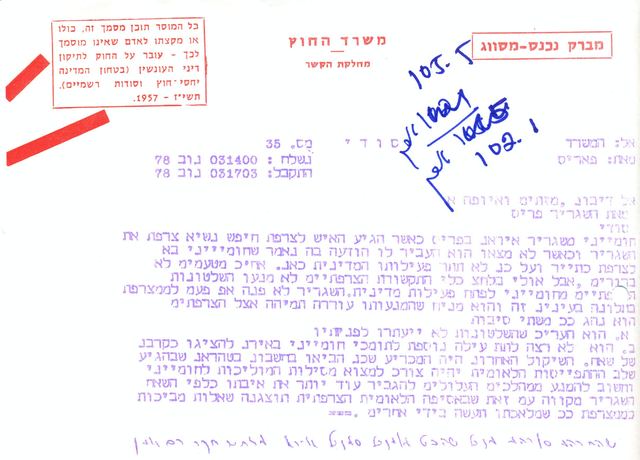
A file from Prime Minister Menachem Begin’s office holds a report on Ambassador Gazit’s conversation with the Secretary-General of the French Foreign Ministry. And in the photograph collection: a reception at the French Senate in honour of Yaakov Tsur, showing, according to the catalogue, Tsur, Ambassador Gazit and Alain Poher.
The index
722 files that are open or partly open, each with a link to the State Archives. The 23 closed files are not listed. File names and descriptions are in Hebrew, as in the catalogue.
A closer reading
3 September 1954 · London
What makes a channel possible?
In a secret letter, Gazit examined British mediation for confidential contact with Jordan. He raised questions about its aims, secrecy and relationship to existing channels. The editor’s note records that Britain ultimately withdrew from the initiative.Archive document
Israel State Archives, Documents on Foreign Policy, vol. 9, ed. Na‘ami Barzilay, 2004. Document 347, pp. 588–589; original 130.15/3745/3. Letter and both editorial notes read.
20 September 1955 · Rangoon
The Asian diplomatic arena
A Foreign Ministry telegram to Gazit in Rangoon concerned relations with China. It instructed the recipients to explain Israel’s UN abstention, while a positive response to the proposal for diplomatic relations was still awaited. Gazit was a recipient of these instructions.Archive document
Israel State Archives, Documents on Foreign Policy, vol. 10, ed. Yemima Rosenthal, 2016. Document 381, p. 564; original 130.09/2326/3. Telegram and note read.
March–April 1975
Defining the contact
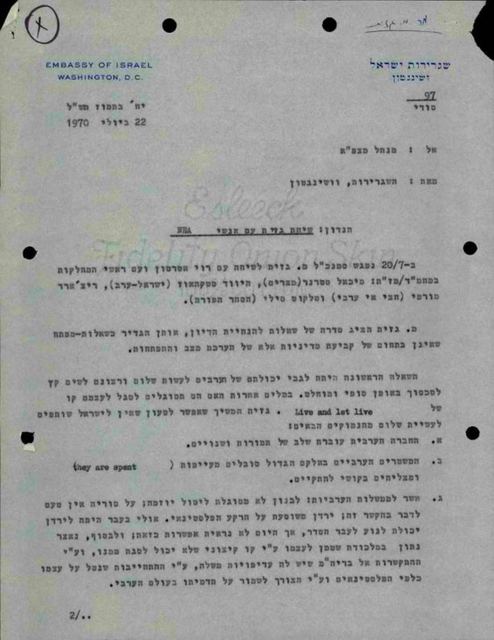
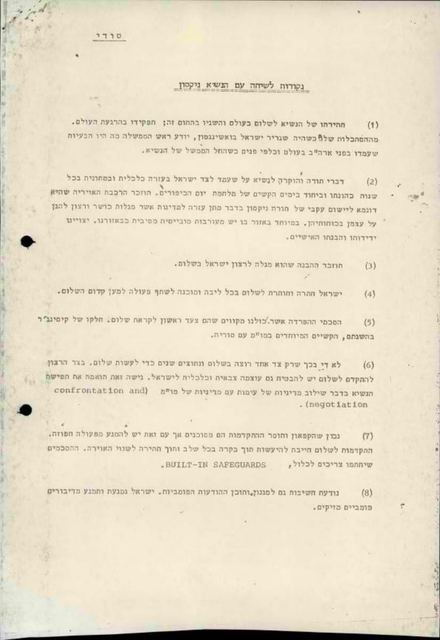
In a signed memorandum, Gazit distinguished the Soviet contacts from negotiations. His record of the 4 April meeting returns to the question of whom the visitors represented. It documents the effort to clarify the channel’s status.Archive document
Memoranda of 31 March 1975 and a 4 April conversation recorded on 6 April document the Soviet channel’s principles and the dispute over its status. 1 January 1974–15 April 1975 (cover). חצ-6823/8 · 000azrg
Keep the file number. Open the next door.
Selected files from the archive’s official public Pinpoint collection, plus an ISA copy preserved at NYU.