
One of his three working files on the negotiations with Syria, from 1974. It holds papers he prepared for the Defence Minister, for the Prime Minister and for the American Secretary of State, and a summary over his handwritten signature of what was still open three days before the signing.
Scan: Israel State Archives, file HZ-5976/2 ↗. One page of the file’s 264 is shown here; the file itself is kept at the Archives.
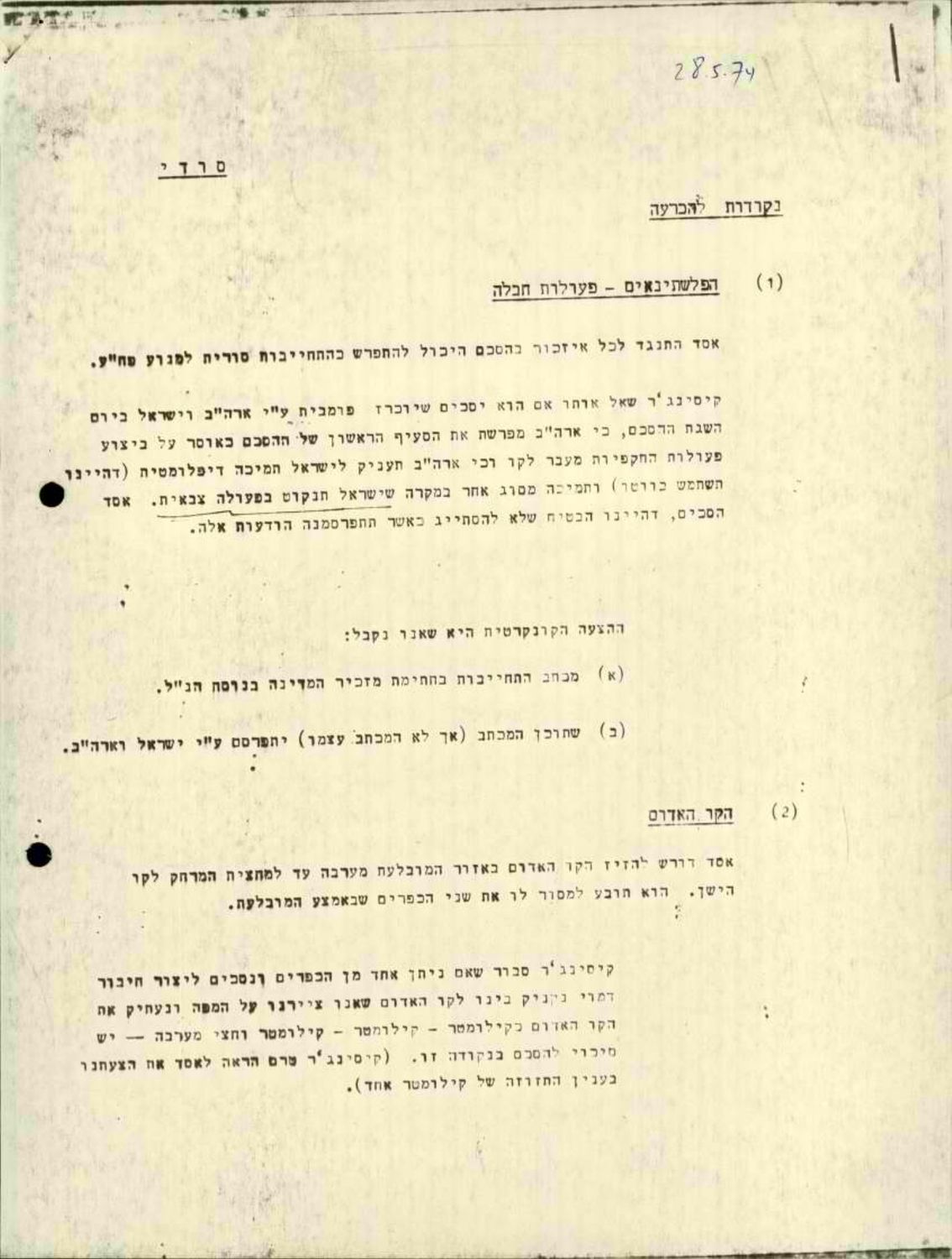
What the file shows, in the words on the page
20 March 1974
The memorandum the Defence Minister asked for
On 17 March the government approved the journey of the Defence Minister, Moshe DayanDefence Minister, 1967–1974, and Foreign Minister, 1977–1979.What they wanted: Defensible borders; and after 1977, as foreign minister, peace with Egypt.More on Moshe Dayan in “People and events” →, to Washington for talks with Henry KissingerU.S. National Security Adviser and Secretary of State.What they wanted: To push the Soviet Union out of the Middle East and make the United States the only broker, through step-by-step agreements.More on Henry Kissinger in “People and events” →. Three days later Gazit sent the Minister’s bureau a memorandum marked “top secret”, “Disengagement with Syria (summary and guidelines)”. In the covering letter, “from: the Director-General”: “Attached is the memorandum the Defence Minister asked for. The Prime Minister has approved it.”
At the foot of the memorandum’s first page, by hand: the initials M.G. and the date. The memorandum opens with the government’s decision, and among the things to be raised in the negotiations it lists “the demand to permit the departure of the Jews of Syria who wish to leave” (site translations). The military details in the memorandum and its annex are not given here.
2 May 1974
What the Secretary would raise in Damascus: the Jews of Syria, and the body of Eli Cohen
For Henry KissingerU.S. National Security Adviser and Secretary of State.What they wanted: To push the Soviet Union out of the Middle East and make the United States the only broker, through step-by-step agreements.More on Henry Kissinger in “People and events” →’s talks in Damascus Gazit prepared two sheets in English. At the foot of both is written by hand, in Hebrew, “prepared by M.G.”, and on the same day he wrote to Ambassador Simcha DinitzIsrael’s ambassador in Washington from 1973.What they wanted: American arms and support, during the war and after it.More on Simcha Dinitz in “People and events” →: “Attached is the paper I prepared. Further changes may yet be made to it” (site translation). The first sheet lists eleven points for the disengagement agreement.
The second, “Additional matters to be taken up by the Secretary with Pres. Hafez al-AssadPresident of Syria, 1971–2000.What they wanted: To recover the Golan Heights for Syria.More on Hafez al-Assad in “People and events” →”, opens with “Emigration of Syrian Jews wishing to leave Syria” and includes “Return of the body of Eli CohenAn Israeli agent in Damascus; caught and executed in Syria in 1965.More on Eli Cohen in “People and events” →”.
From the same day there is also a sheet of points in Hebrew, “For the Prime Minister’s talk with the Secretary in private”, initialled M.G., with “Rescue of the Jews of Syria” and “The Jews of the USSR” among them.
28 May 1974
“Points for decision”: eight open questions
Three days before the signing Gazit summed up in three pages, marked “secret” and signed by hand, what was still open after Henry KissingerU.S. National Security Adviser and Secretary of State.What they wanted: To push the Soviet Union out of the Middle East and make the United States the only broker, through step-by-step agreements.More on Henry Kissinger in “People and events” →’s talks in Damascus: sabotage operations, the two lines, Mount Hermon, the timetable, the police, the documents of the agreement and the UN force. On each point he set down what Hafez al-AssadPresident of Syria, 1971–2000.What they wanted: To recover the Golan Heights for Syria.More on Hafez al-Assad in “People and events” → demanded and what the Secretary proposed.
On the timetable: “He demands five days and we proposed seven days.” And on the line: “Kissinger believes that if we give one of the villages and agree to create a sausage-shaped link between it and the red line that we drew on the map […] there is a chance of agreement on this point” (site translations).
On the same day Kissinger reported at the Prime Minister’s Office on the last stage of the negotiations, and Gazit sat in the discussion.
28 August 1974
The road to the Hermon: a text he dictated
Three months after the agreement Israel turned to the United States about a road the Syrians were building to the summit of Mount Hermon.
The Minister in Washington, Mordechai ShalevMinister at the Israeli embassy in Washington.More on Mordechai Shalev in “People and events” →, delivered the message to Harold SaundersU.S. National Security Council staff, the White House body that advises the president on foreign and security affairs.What they wanted: To prepare texts and options for Kissinger’s negotiations.More on Harold Saunders in “People and events” →, and recorded in a letter of 4 September that it was delivered “in accordance with the text dictated to me by Mr Gazit […] and approved orally by the Foreign Minister” (site translation).
The text, in English, ends: “We regard the Syrian action as a grave violation of the military situation and one that implies aggressive intentions, in complete contradiction to the Disengagement Agreement. We request the Secretary’s intervention to have the work stopped.”