
The Archives’ catalogue calls the file “The Prime Minister’s messages, 73–75”: personal correspondence from the Director-General’s bureau about the Prime Minister’s messages, with two heads of mission, the Ambassador in Bonn and the envoy in Tehran. Two letters of his show how the personal channels of the Prime Minister, Golda Meir, were run, and how he wrote to colleagues.
Scan: Israel State Archives, file HZ-5980/11 ↗. One page of the file’s 67 is shown here; the file itself is kept at the Archives.
What the file shows, in the words on the page
26 August 1973
The special channel to Brandt
A letter marked “personal – secret” to Israel’s Ambassador in Bonn, Eliashiv Ben-HorinIsrael’s Ambassador in Bonn, the West German capital, in the early 1970s.More on Eliashiv Ben-Horin in “People and events” →, “from: the Director-General”. In it Gazit explains how the Prime Minister sees the channel: “The Prime Minister believes that Willy BrandtWest German chancellor, 1969–1974, and Nobel Peace Prize laureate; visited Israel in June 1973.What they wanted: Close ties with Israel alongside closeness to the Arab states: a “balanced policy”.More on Willy Brandt in “People and events” →’s proposal, during his visit here, to set up a special channel is of importance.”
The condition is that the exchange of letters be kept secret, “their content and their very existence”. Then three rules: when a letter goes in a sealed envelope, and when the Ambassador receives a copy.
And the ending, almost an apology: “Were we not afflicted with the plague of leaks, it would have been possible to pull the strap a little less tight, but for the time being it cannot be loosened, and the Prime Minister relies on your cooperation” (site translations).
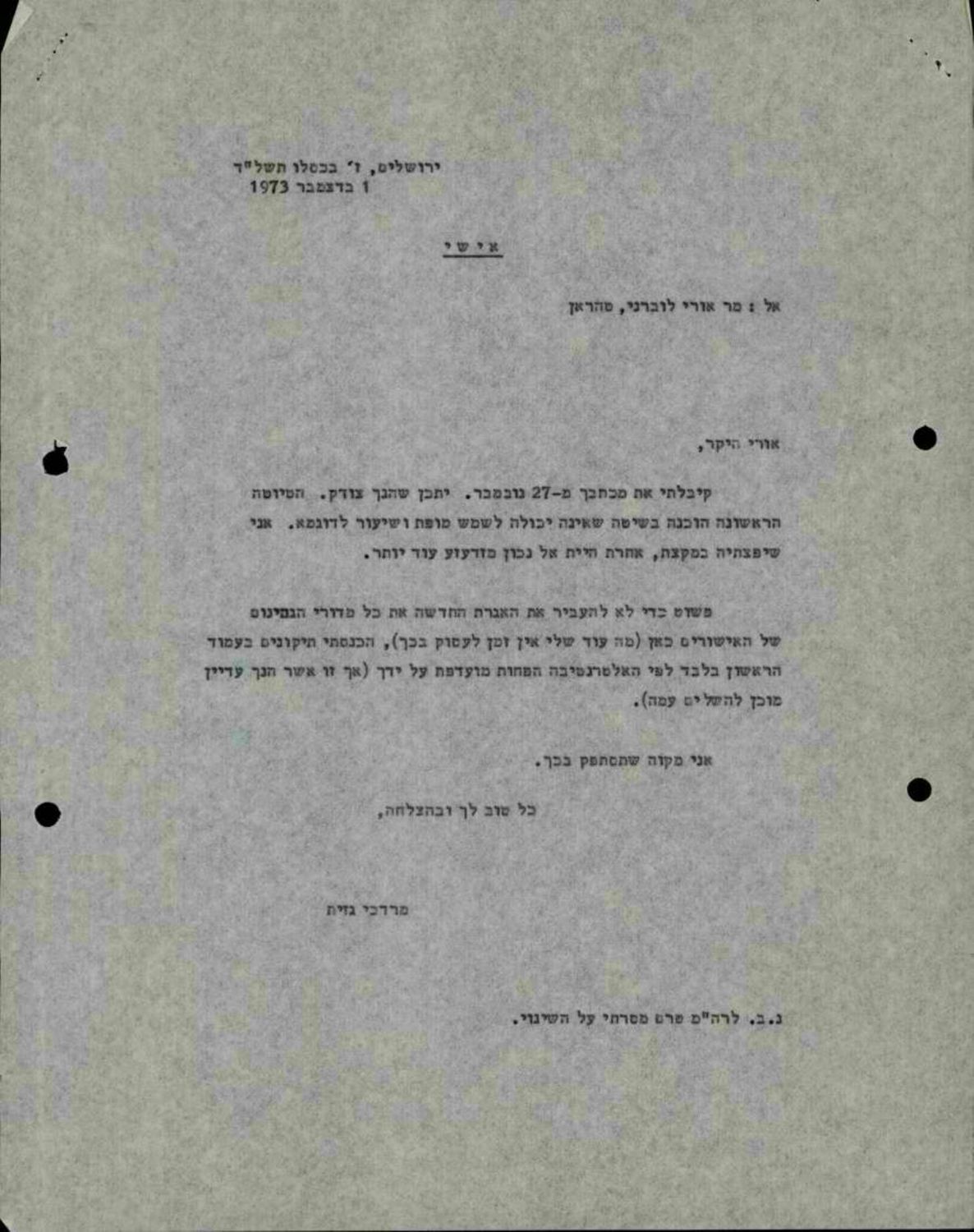
1 December 1973
“All the circles of hell of the approvals”
A letter marked “personal” to Uri LubraniDiplomat; head of Israel’s mission in Tehran, 1973–1978.More on Uri Lubrani in “People and events” → in Tehran, five weeks after the war. Lubrani, who opened his own letter “To Motke, warm greetings”, had commented on the wording of a message from the Prime Minister to Mohammad Reza Shah PahlaviThe Shah of Iran, 1941–1979; overthrown in the Islamic Revolution.More on Mohammad Reza Shah Pahlavi in “People and events” →, and proposed another.
Gazit answered without defending himself: “You may well be right. The first draft was prepared by a method that cannot serve as a model or an example. I touched it up a little, otherwise you would surely have been even more shocked.”
And then, on how a prime minister’s letter gets corrected: “Simply so as not to put the new message through all the circles of hell of the approvals here (all the more as I have no time for it), I made corrections on the first page only” (site translations).