
On the cover, by hand: “M. Gazit’s visits to Washington”. The file holds the embassy’s records of his talks at the State Department in July 1970 and September 1971, five years after he ended his own term there as Minister. The records were written by embassy staff, and his words are given here as they set them down.
Scan: Israel State Archives, file HZ-5973/2 ↗. One page of the file’s 50 is shown here; the file itself is kept at the Archives.
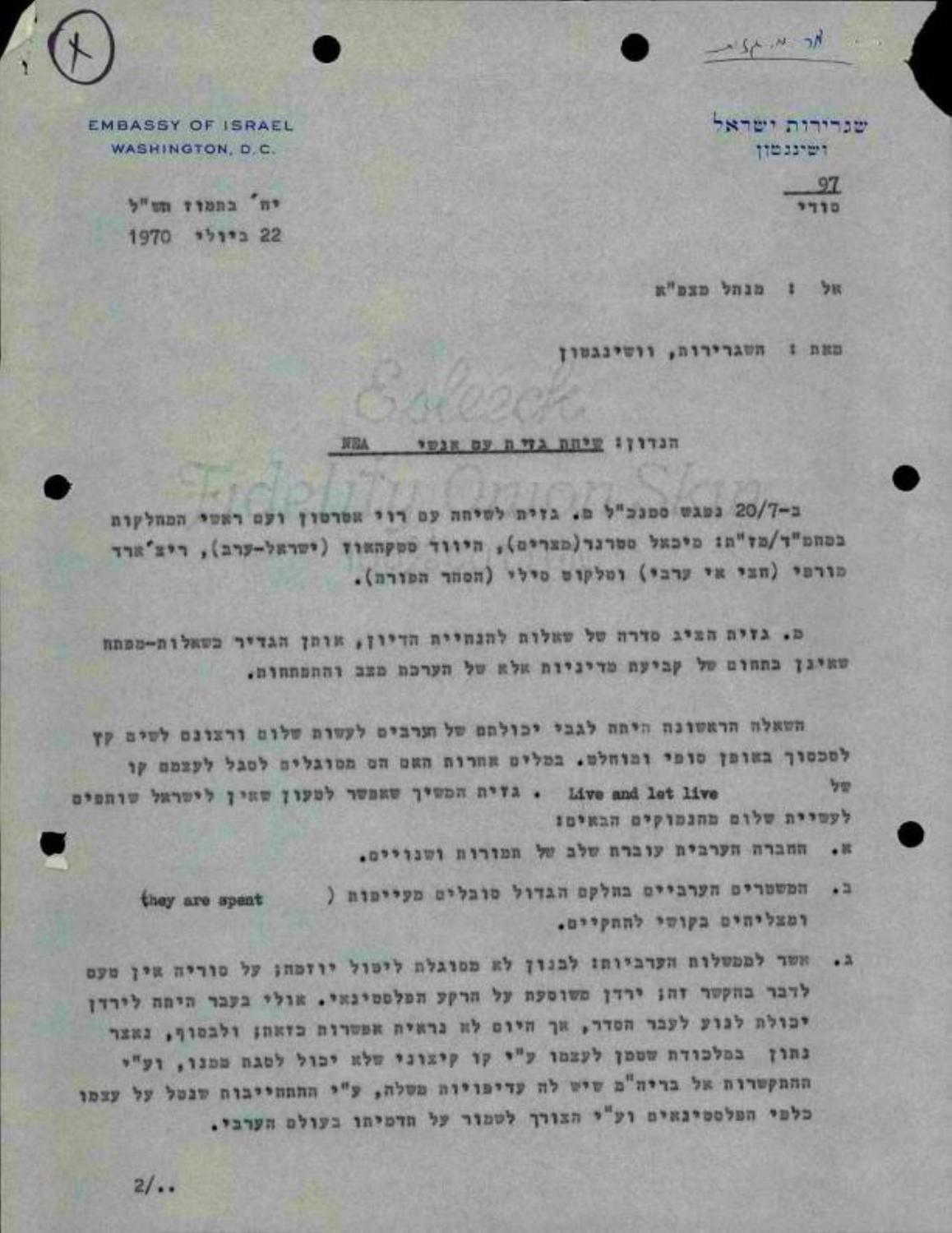
What the file shows, in the words on the page
20 July 1970
“Live and let live”
A talk with Roy AthertonAn American diplomat, a senior official of the State Department’s Near East bureau; later Assistant Secretary of State and Ambassador to Egypt.More on Roy Atherton in “People and events” → and the heads of the Near East offices at the State Department.
According to the embassy’s record: “M. Gazit put a series of questions to guide the discussion, which he defined as key questions belonging not to the making of policy but to the assessment of the situation and its development. The first question concerned the Arabs’ ability to make peace and their wish to put an end to the conflict finally and completely. In other words, are they capable of adopting a line of Live and let live” (site translation; the last four words are in English in the original).
September 1971
“The storm in a teacup”
With Samuel De PalmaUS Assistant Secretary of State for International Organization Affairs.More on Samuel De Palma in “People and events” → again. The embassy’s cable records: “Gazit said that our assumption is that nothing good can grow out of the Assembly. We shall get through this road of suffering and ‘the storm in a teacup’. The whole matter seems far less important than a few years ago. That, in our view, is the healthy approach to the UN” (site translation).
On the partial Canal arrangement De Palma said: “Israel underestimated very much how far the Egyptians have come.” Gazit, according to the cable, doubted whether the Egyptians were ready to see the partial arrangement as first of all an agreement to open the Canal.