
A Foreign Ministry file that bears his name: messages and letters between the Prime Ministers, Golda Meir and Yitzhak Rabin, and Presidents Nixon and Ford, with the cables that carried them, some of them over his signature.
Scan: Israel State Archives, file HZ-5977/2 ↗. One page of the file’s 274 is shown here; the file itself is kept at the Archives.
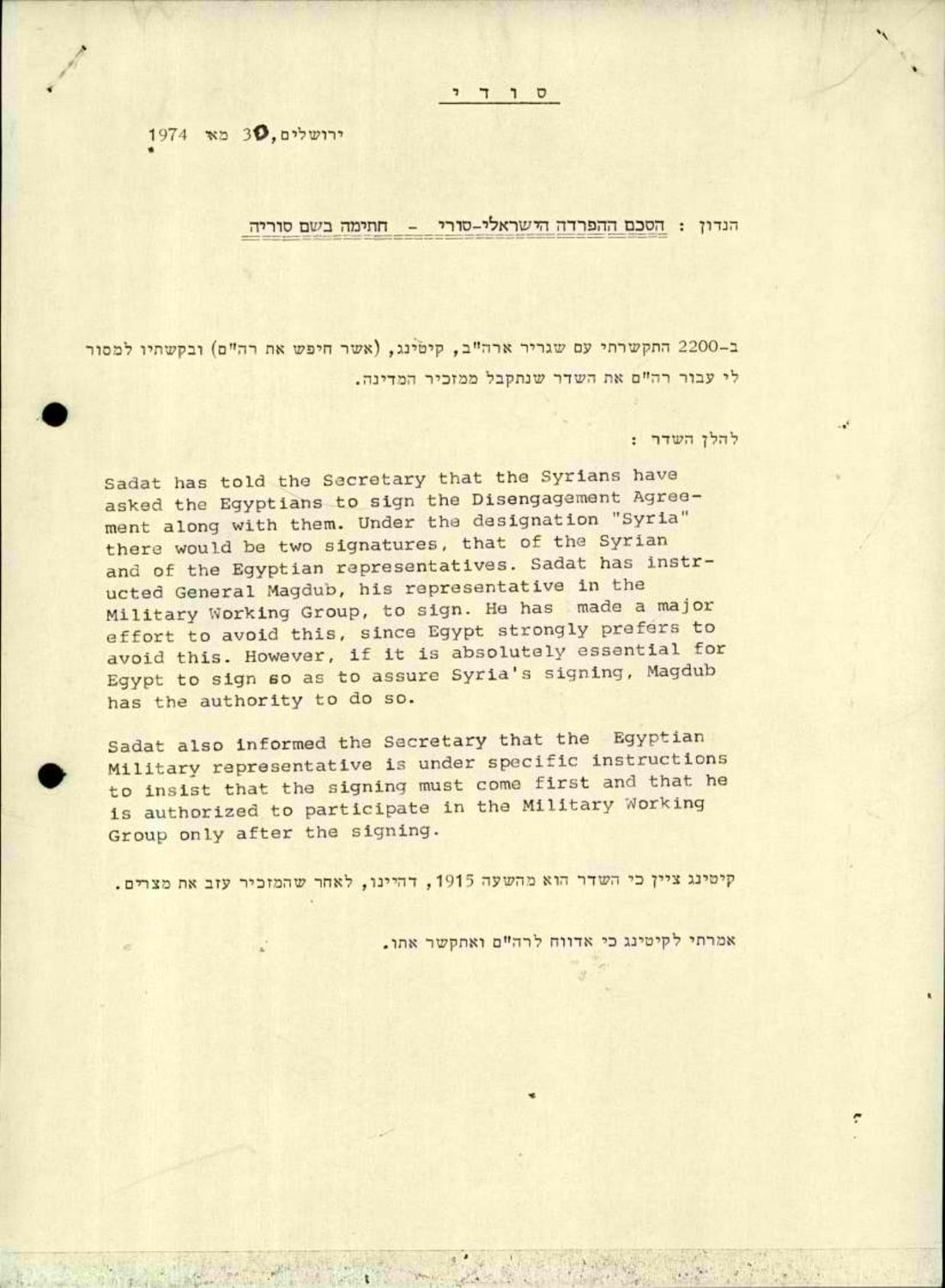
What the file shows, in the words on the page
30–31 May 1974
One night, hour by hour
A three-page memorandum, signed by hand, on the night before the disengagement agreement with Syria was signed. At 22:00 he took from US Ambassador Kenneth KeatingUnited States ambassador to Israel, 1973–1975.More on Kenneth Keating in “People and events” → the Secretary of State’s message: the Syrians had asked that an Egyptian representative sign as well.
At midnight, after the ministers had met, he telephoned Golda MeirPrime Minister, 1969–1974. Gazit headed her office twice: when she was Foreign Minister in the late 1950s, and as Director-General of the Prime Minister’s Office from 1973.What they wanted: Security for Israel, and peace through direct negotiation, without a return to the 1967 lines.More on Golda Meir in “People and events” →’s reply to the Ambassador’s deputy: Israel agreed, on condition that the signature be on behalf of Syria only and that Egypt would not thereby become a party to the agreement. At 03:20 Henry KissingerU.S. National Security Adviser and Secretary of State.What they wanted: To push the Soviet Union out of the Middle East and make the United States the only broker, through step-by-step agreements.More on Henry Kissinger in “People and events” →’s confirmation came in.
“At 0630 I brought A. Kidron into the picture and dictated to him the text of a cable that went out over his signature to our delegation in Geneva” (site translation). At 06:50 he telephoned the answer to Golda Meir, to Yitzhak RabinPrime Minister, 1974–1977; earlier Deputy Chief of Staff and ambassador in Washington.What they wanted: To move step by step, through interim agreements, in return for American guarantees and arms.More on Yitzhak Rabin in “People and events” → and to Colonel Arie BraunAn officer in the Defence Minister’s bureau; military secretary to Moshe Dayan.More on Arie Braun in “People and events” →.
August 1974
From Nixon to Ford: the channel carries on
On 10 August 1974 a top-secret cable went to Washington over his signature with the text of the message Ambassador Keating had delivered to the Prime Minister from the new President, Gerald FordPresident of the United States, 1974–1977.What they wanted: To continue Kissinger’s path: a second interim agreement between Israel and Egypt.More on Gerald Ford in “People and events” →. On 16 August Yitzhak RabinPrime Minister, 1974–1977; earlier Deputy Chief of Staff and ambassador in Washington.What they wanted: To move step by step, through interim agreements, in return for American guarantees and arms.More on Yitzhak Rabin in “People and events” →’s reply went out over his signature.
A day earlier, as “the Political Adviser and Director-General”, he sent the ambassador in Washington Rabin’s personal letter to Richard NixonPresident of the United States, 1969–1974.What they wanted: Stability in the Middle East and a check on Soviet influence, without a direct clash between the powers.More on Richard Nixon in “People and events” →, who had resigned that month, adding: “We suggest that the letter be delivered to him personally through the Consul-General in Los Angeles” (site translation).
In the letter Rabin wrote to Nixon: “Israel will not forget the Airlift that you ordered during the Yom Kippur War.”
15 November 1974
“The message should not be too long”
A top-secret note from Tel Aviv to a colleague whose first name is Gershon (his surname is not on the page): “The idea is a message from the Prime Minister to Ford ahead of the summit.” Ford was to leave the United States within two or three days, “so the matter is urgent”.
Then the guidance: “In my view: (a) the message should not be too long; (b) built on the points in Annex A (not necessarily in that order).” And on whether to mention the Vladivostok summit: “it seems to me better to ignore it” (site translations).