
The embassy’s file on the visit of Deputy Defence Minister Shimon Peres to Washington in May 1962. It opens with a four-page summary report “From: the Minister, Washington” to the Foreign Minister, Golda Meir, over the typed signature M. Gazit, followed by eight enclosures.
Scan: Israel State Archives, file HZ-5983/1 ↗. One page of the file’s 63 is shown here; the file itself is kept at the Archives.
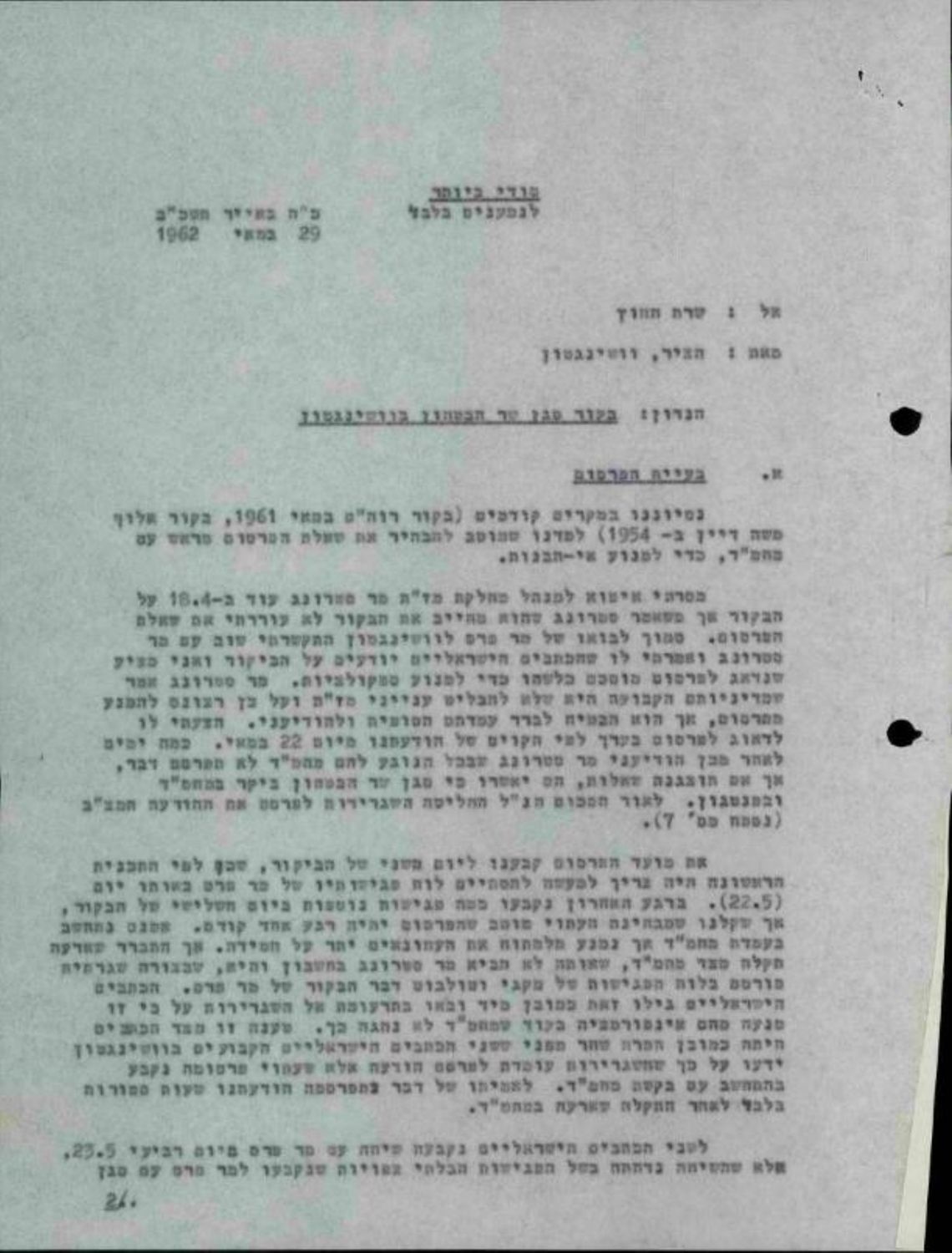
What the file shows, in the words on the page
23 May 1962
The question to Strong
The record of Peres’s lunch with Robert StrongDirector of the State Department’s Near East office, 1962.More on Robert Strong in “People and events” →, director of the Near East office at the State Department, notes: “Present: M. Gazit”.
And in the body: “Gazit asked whether Strong’s words meant that, for the American position to move, the assessments had to change in both the military and the political field, or whether a change in one of them was enough. Strong replied that a change in one of them was enough” (site translation).
According to the summary report, the record of the meetings at the State Department was written by Gazit himself.
29 May 1962
“The old truth about the United States”
In the summary report he wrote: “The talks at the Pentagon can, I think, be summed up as friendly, yet as confirming the old truth about the United States: that the Pentagon will act only after a political decision has been taken.” And he concluded: “Our assessment is that this was a timely visit and a useful one” (site translations).
Copies went to the Prime Minister, to Peres, to the Chief of Staff and to the Director-General of the Foreign Ministry.
29 May 1962
The White House, in the idiom of the Mishnah
Of the meetings at the White House he wrote that one could not speak “in one generalising sentence, because there Mr Peres met people whose fields of responsibility differ”, and went on in the Mishnah’s formula for telling cases apart: McGeorge BundyNational security adviser to Presidents Kennedy and Johnson.More on McGeorge Bundy in “People and events” → is not like General Maxwell TaylorGeneral; President Kennedy’s military adviser, and from late 1962 Chairman of the Joint Chiefs of Staff.More on Maxwell Taylor in “People and events” → or Arthur SchlesingerHistorian; special assistant to President Kennedy.More on Arthur Schlesinger in “People and events” →, and those three are not like Myer FeldmanDeputy Special Counsel at the White House; President Kennedy’s point man on Israel.More on Myer Feldman in “People and events” → (site translation and paraphrase).