
His working file on the mission of Gunnar Jarring, the UN Secretary-General’s envoy, from December 1970 to January 1972. About fifteen documents in the file are his own; his name is on the distribution of almost every cable in it. Until December 1971 he signs as Assistant Director-General, and on 16 January 1972 as “the Director-General”.
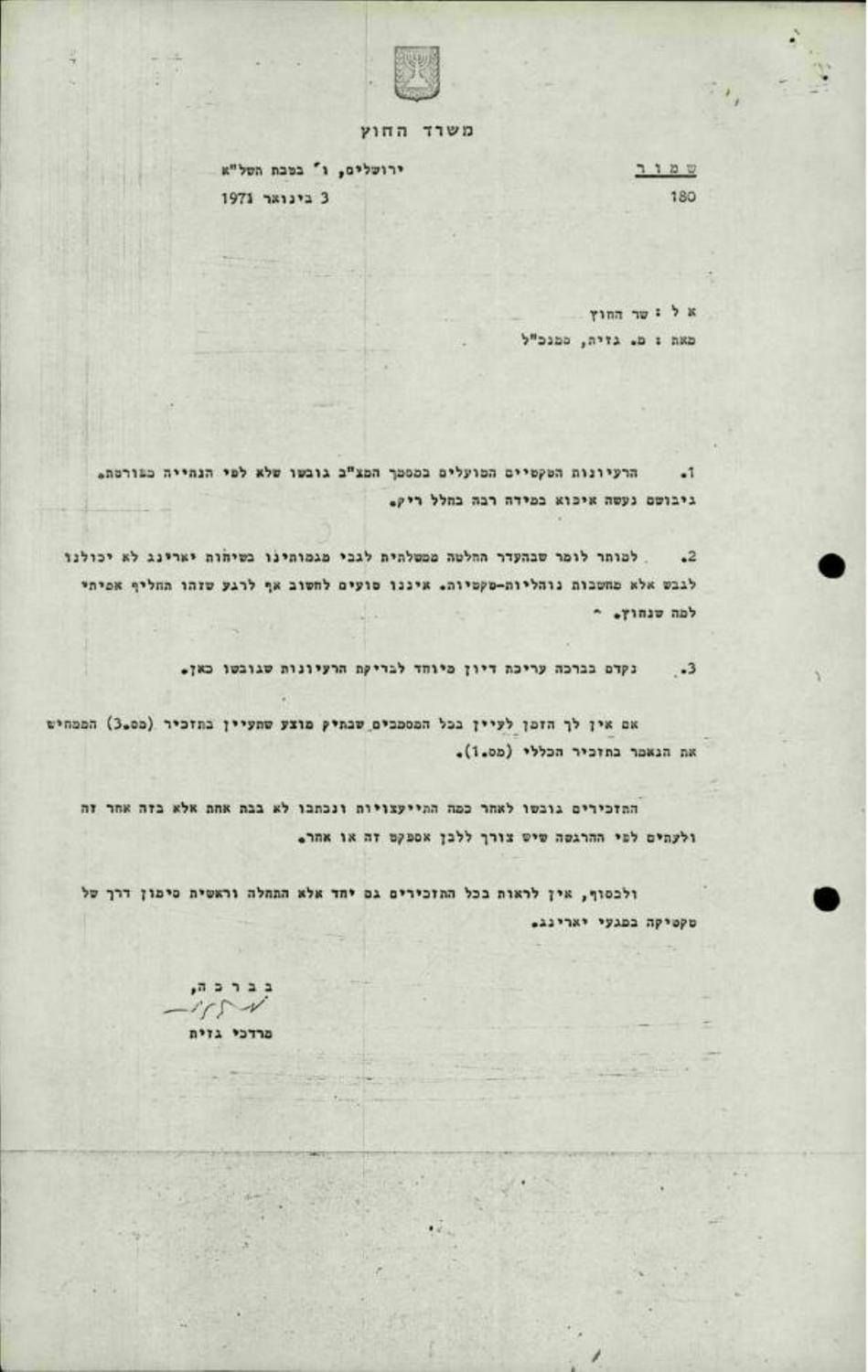
Scan: Israel State Archives, file HZ-5980/7 ↗. One page of the file’s 289 is shown here; the file itself is kept at the Archives.
What the file shows, in the words on the page
December 1970
Chairman of the working group
A secret memorandum to the Foreign Minister, Abba EbanForeign Minister, 1966–1974.What they wanted: To present Israel to the world as a country seeking peace, and to win support for it.More on Abba Eban in “People and events” →, headed “Gunnar JarringSwedish diplomat, UN envoy to the Middle East, 1967–1971.What they wanted: A peace agreement based on Security Council Resolution 242.More on Gunnar Jarring in “People and events” → – the working group”: “The working group met in its full composition: Messrs T. Meron, M. Sasson, M. Elizur, H. Hanan Bar-OnDiplomat; worked beside Gazit, who led the secret channel to Moscow, in the early 1970s.More on Hanan Bar-On in “People and events” → and the undersigned (chairman).” The group met on 23 December, ahead of the renewal of the Jarring talks.
He attached a proposal for “a timetable for achieving a peace treaty”, “based on an idea of Aharon RemezThe first commander of the Israeli Air Force; Israel’s Ambassador in London, 1965–1970.More on Aharon Remez in “People and events” →”, and noted: “The working-out of the memorandum and its detail were done by me” (site translations).
31 December 1970
Giving the Egyptians a pretext not to shoot
A memorandum to the Foreign Minister, “The Gunnar JarringSwedish diplomat, UN envoy to the Middle East, 1967–1971.What they wanted: A peace agreement based on Security Council Resolution 242.More on Gunnar Jarring in “People and events” → talks – notes on the tactical and procedural approach”, over his signature. Egypt was then threatening not to extend the ceasefire. “If the Egyptians are looking for a pretext to say that ‘the conditions have been met’ that allow them not to open fire”, he wrote, “we must give them something for such a pretext to hold on to” (site translation).
3 January 1971
“In a vacuum”
Submitting the group’s ideas to the Minister, he wrote plainly about their limits: “The tactical ideas raised in the attached paper were worked out without an explicit directive. They were therefore formed, to a large extent, in a vacuum.” Without a government decision, he added, the group could form only “procedural and tactical thoughts”: “We do not for a moment make the mistake of thinking that this is a real substitute for what is needed” (site translations).
6 December 1971
“And that is an understatement”: what he thought of Jarring
A memorandum marked “restricted” to the Foreign Minister, Abba EbanForeign Minister, 1966–1974.What they wanted: To present Israel to the world as a country seeking peace, and to win support for it.More on Abba Eban in “People and events” →, over his handwritten signature, copied to the Director-General and to the ambassadors in Washington and at the UN. It opens without preamble: “I have been arguing for many months that Gunnar JarringSwedish diplomat, UN envoy to the Middle East, 1967–1971.What they wanted: A peace agreement based on Security Council Resolution 242.More on Gunnar Jarring in “People and events” → has shown very little diplomatic talent (and that is an understatement).”
He attached a ten-point analysis of the envoy’s moves, and warned that when Jarring returned to action, “we shall very soon be dealing with a mediocre diplomat, so lacking in imagination that it is dangerous to negotiate through him and under his auspices.”
The sharpness is deliberate, and he says so himself: a memorandum “worded in the accepted diplomatic language” would follow, but “so as not to lose time I have meanwhile dictated the abridged analysis”. This is an internal memorandum to the Minister, not a statement to the press.
Israel was then speaking of its readiness to return to the talks, and Gazit, who was responsible for the file, saw it as his duty to tell the Minister plainly whom it would be dealing with.
The diagnosis is followed at once by a practical proposal: “to fight Jarring over every step (in the manner of ‘Who is wise? He who foresees what is coming’, that is, by ‘preventive diplomacy’). On no account should we settle for passivity and a method of ‘trust Gunnar’.”
And at the end he proposed discussing it with the Americans too, “at the working level” (site translations).
16 January 1972
The Director-General passes on the line
A secret letter to the ambassador at the UN, Yosef TekoahIsrael’s Ambassador to the UN, 1968–1975.More on Yosef Tekoah in “People and events” →, “From: the Director-General”. In it Gazit passes on remarks he heard from the Prime Minister, Golda MeirPrime Minister, 1969–1974. Gazit headed her office twice: when she was Foreign Minister in the late 1950s, and as Director-General of the Prime Minister’s Office from 1973.What they wanted: Security for Israel, and peace through direct negotiation, without a return to the 1967 lines.More on Golda Meir in “People and events” →: “We must approach the Gunnar JarringSwedish diplomat, UN envoy to the Middle East, 1967–1971.What they wanted: A peace agreement based on Security Council Resolution 242.More on Gunnar Jarring in “People and events” → contacts in complete sobriety: Jarring will not bring us peace.”
Even so his invitations should be accepted and he should be spoken to courteously: “That is the line and nothing is to be added to it.” Then he added a point of his own: Israel would see “a most negative development” if it turned out that Anwar SadatPresident of Egypt, 1970–1981.What they wanted: To get Sinai back for Egypt, and move Egypt from Soviet to American patronage.More on Anwar Sadat in “People and events” →’s slogan, “only Jarring”, also covered the efforts for a Canal arrangement (site translations).