
On the cover, by hand: “M. Gazit”, “after Washington and during K.’s visit in August 75”. The file holds the drafts of the agreement, and papers he wrote in a single week, from 22 to 28 August 1975, to the Deputy Prime Minister and Foreign Minister, Yigal Allon: what to amend in the text, and how the agreement would be presented after it was signed.
Two pages from the file
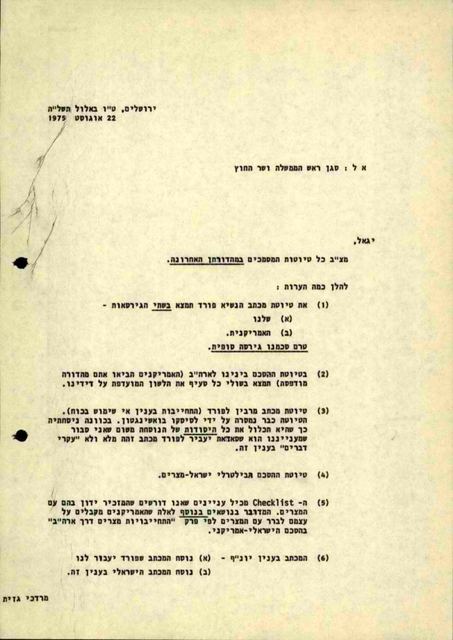
22 August 1975: “Yigal, attached are all the draft documents in their latest edition” 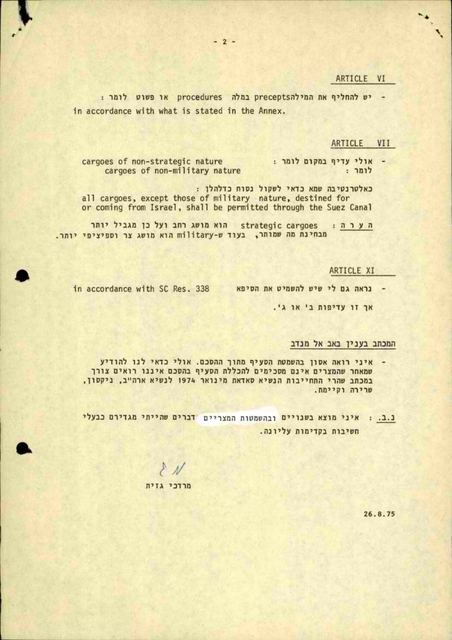
26 August 1975: “Mordechai Gazit’s remarks on the Egypt–Israel agreement”, the second page, with his signature
Scans: Israel State Archives, file HZ-5974/15 ↗. Two pages of the file’s 135 are shown here; the file itself is kept at the Archives.
What the file shows, in the words on the page
22 August 1975
All the drafts, “in their latest edition”
A note to “the Deputy Prime Minister and Foreign Minister”, opening with his first name: “Yigal, attached are all the draft documents in their latest edition.” Six numbered remarks follow on what is in the bundle: the drafts of the agreement, the letters and the lists.
Of one of them he wrote: “A draft letter from Yitzhak RabinPrime Minister, 1974–1977; earlier Deputy Chief of Staff and ambassador in Washington.What they wanted: To move step by step, through interim agreements, in return for American guarantees and arms.More on Yitzhak Rabin in “People and events” → to Ford (an undertaking on the non-use of force). I have already handed the draft to Joseph SiscoAssistant Secretary of State for Near Eastern Affairs, the senior State Department official responsible for the region.What they wanted: To advance the American initiatives and bridge the parties’ positions.More on Joseph Sisco in “People and events” → in Washington. I deliberately worded it so that it contains all the elements of the formula, because I believe it is in our interest that Anwar SadatPresident of Egypt, 1970–1981.What they wanted: To get Sinai back for Egypt, and move Egypt from Soviet to American patronage.More on Anwar Sadat in “People and events” → should send Ford an identical, full letter and not ‘the main points’ on this matter” (site translations).
22 August 1975
“A decree from which there is no escape”? What Sadat would say after the signing
A memorandum marked “restricted” to Yigal AllonDeputy Prime Minister, and Foreign Minister in Rabin’s government.What they wanted: Defensible borders, and a territorial compromise with Jordan (the “Allon Plan”).More on Yigal Allon in “People and events” →, “from: Mordechai Gazit”, on “The presentation of the agreement by Egypt”.
“In March 1975 the Secretary of State told us that we must be prepared for President Anwar SadatPresident of Egypt, 1970–1981.What they wanted: To get Sinai back for Egypt, and move Egypt from Soviet to American patronage.More on Anwar Sadat in “People and events” → to make statements, after the agreement is signed, that will not be pleasant to our ears. I wondered at this then, and I did not think, nor do I think today, that we must accept them as a decree from which there is no escape.”
He rests on experience: after the disengagement agreement of January 1974, “Egypt behaved correctly and President Sadat made responsible statements”. Hence the proposal: to reach, through the United States and “on a basis of reciprocity”, a few rules of conduct. The first: “Egypt will present the agreement as a positive and significant step towards peace” (site translations).
26 August 1975
Remarks on the text: word against word
“Mordechai Gazit’s remarks on the Egypt–Israel agreement”, two pages, marked “secret”, over his handwritten signature. Article by article, each remark with a grade of priority: A, B or C. On an article that Egypt wanted worded in its own name alone: “I assume this is because they want to gain the standing of ‘the mouth that permitted is the mouth that forbade’.”
On the cargoes to be allowed through the Suez Canal he proposed writing non-military instead of non-strategic, and explained: “strategic cargoes is a broad concept and therefore more restrictive as to what is permitted, whereas military is a narrower and more specific one.”
And in a postscript, with a sense of proportion: “I do not find in the Egyptian changes and omissions things that I would define as being of the highest priority” (site translations).
26 August 1975
“A significant step towards peace”
Four days after the first memorandum he came back to Yigal AllonDeputy Prime Minister, and Foreign Minister in Rabin’s government.What they wanted: Defensible borders, and a territorial compromise with Jordan (the “Allon Plan”).More on Yigal Allon in “People and events” → with a defined proposal: “I now propose specifically that it be agreed with Egypt that its public presentation and ours (each separately, of course) will stress that the agreement is a significant step towards peace”. The words, he noted, are already written in the agreement itself.
And should Egypt answer that it would not stress this itself, it should be agreed that Israel may say: “Israel will note in its public presentation that the agreement itself states that it constitutes a significant step towards peace. Israel wishes to regard this statement with trust and optimism” (site translations).