
A nine-page memorandum, signed by hand, that he wrote in July 1990 for the oral-history section of the Davis Institute: “A critique of Shimon Peres’s moves to advance the ‘Jordanian option’ as the basis for a settlement”. With it he filed a letter he had sent to a senior American diplomat, and six annexes. Here he is already a scholar, ten years after retiring, but a scholar who had himself taken part in the contacts with Jordan.
Two pages from the file
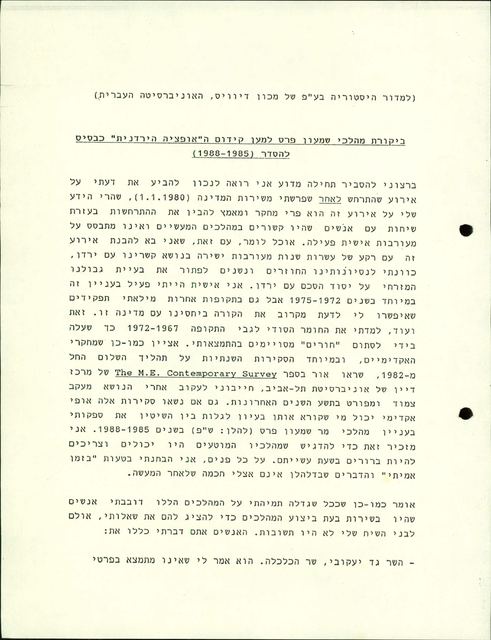
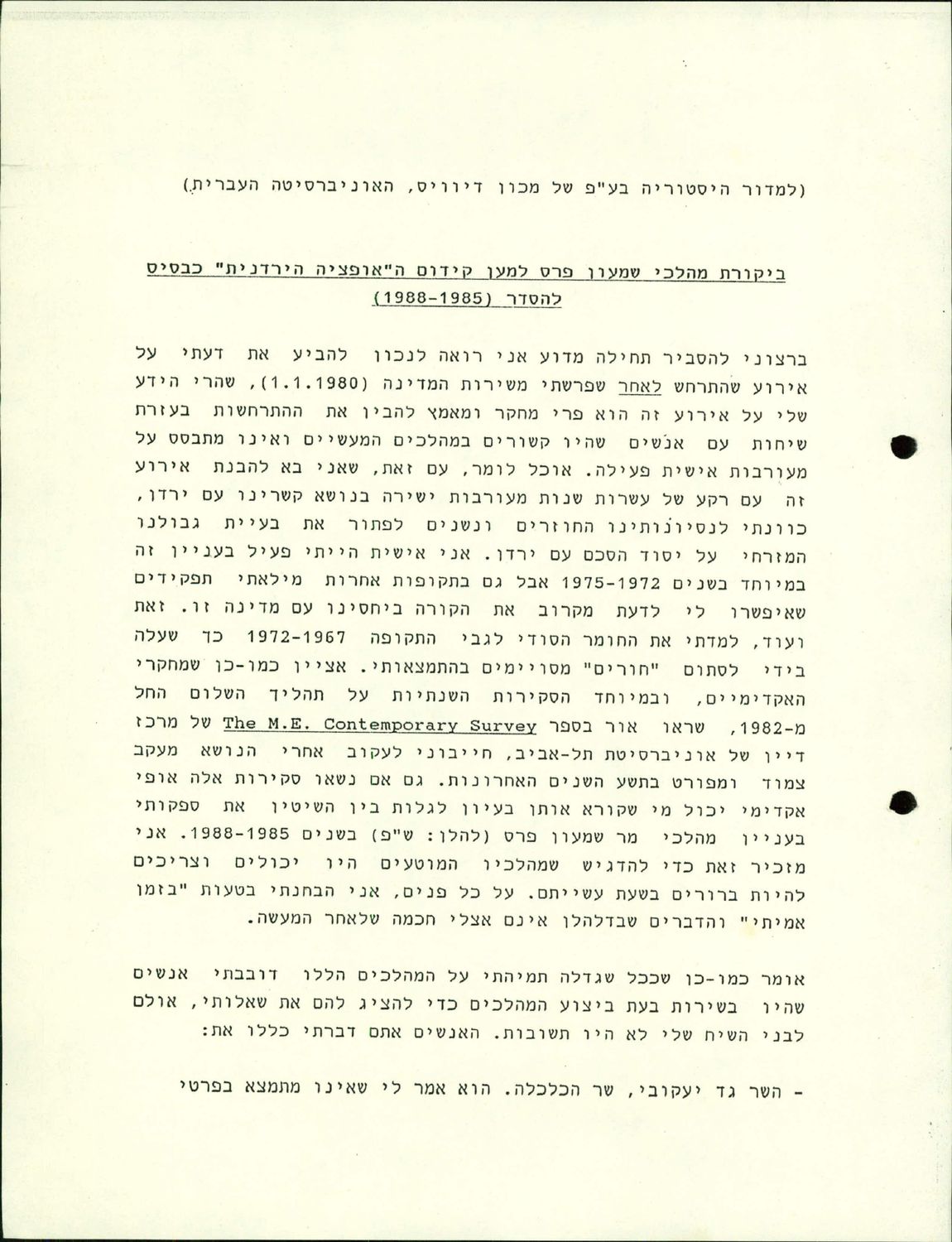
10 July 1990: the first page of the memorandum 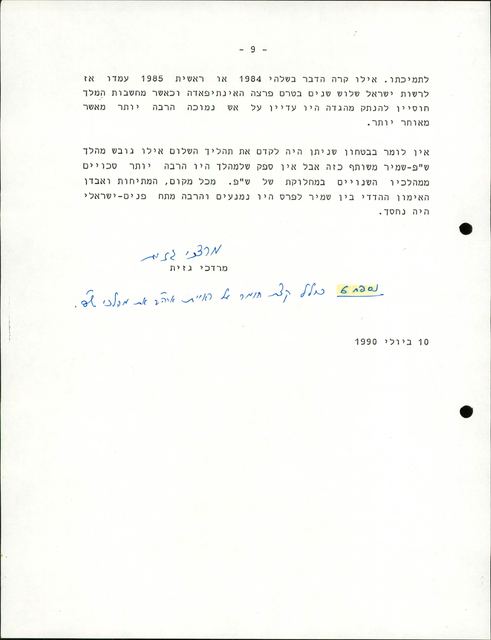
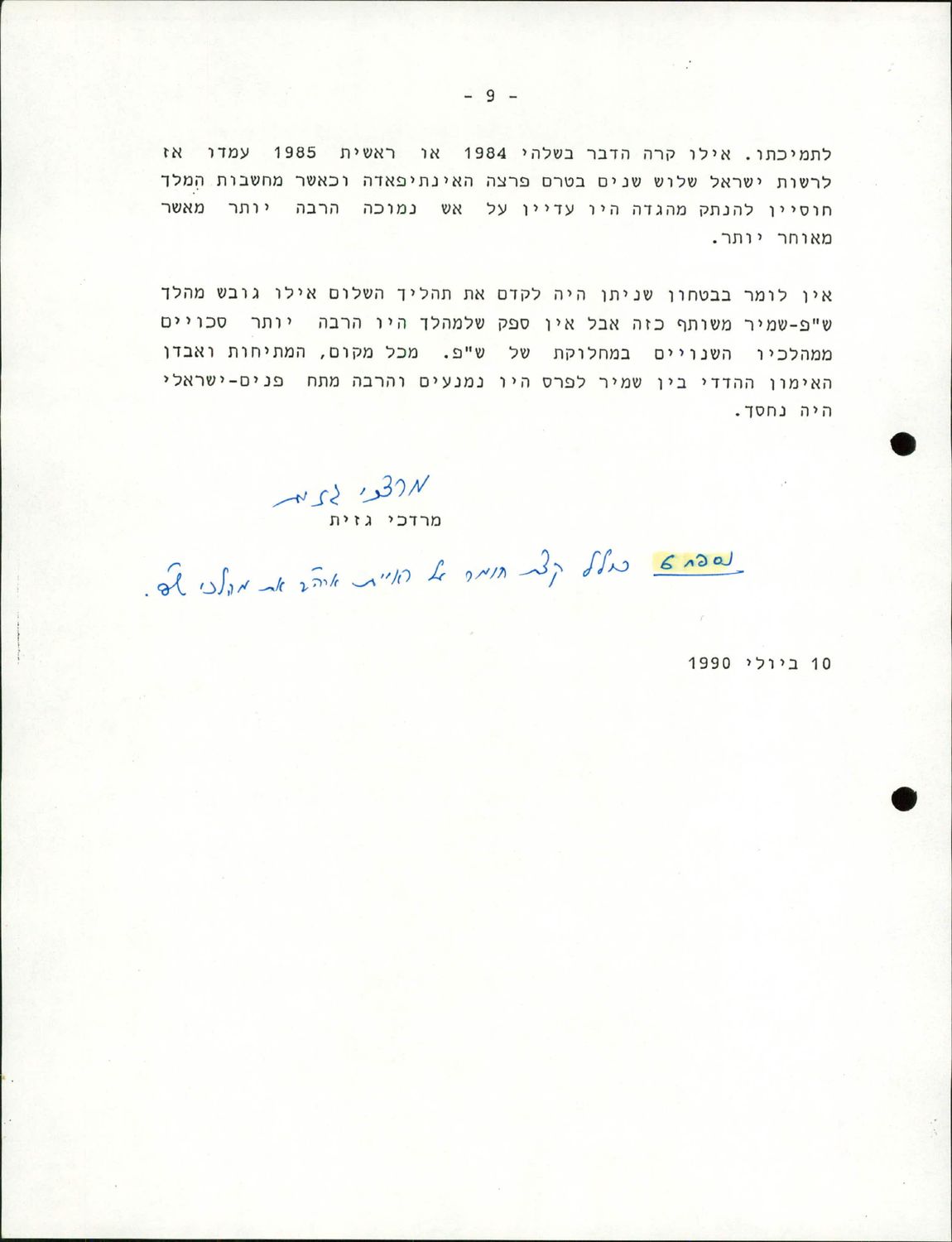
The last page, with his signature, 10 July 1990
Scans: Israel State Archives, file A-7784/7 ↗. Two pages of the file’s 26 are shown here; the file itself is kept at the Archives.
What the file shows, in the words on the page
16 December 1989
“The London Document was stillborn”: a letter to Richard Murphy
A letter in English to Richard MurphyUS Assistant Secretary of State for Near Eastern affairs, 1983–1989.More on Richard Murphy in “People and events” →, who was Assistant Secretary of State for Near Eastern affairs in the years when the understanding between Peres and King HusseinKing of Jordan, 1952–1999.What they wanted: To keep his kingdom safe between Israel, the Arab states and the Palestinians, and to regain the West Bank.More on King Hussein in “People and events” → took shape. Gazit puts “historical questions” to him, and the first is: why was it assumed that Hussein would be able to find Palestinian delegates for a joint delegation, without the PLO’s consent?
And his conclusion: “I posit, therefore, that for this reason alone the London Document was stillborn.” And had Secretary of State George ShultzUS Secretary of State, 1982–1989.More on George Shultz in “People and events” → “heeded Peres’s advice and visited the region sometime early in May, he would have found that Hussein could not deliver the goods.” The file holds a copy of the letter, on his own letterhead and with his typed name.
10 July 1990
Why he wrote: “it is important that he find this memorandum too”
The memorandum opens with the question of why he is giving an opinion on something that happened after he retired. His answer: “I come to the understanding of this event with a background of decades of direct involvement in the matter of our ties with Jordan”, and “I personally was especially active in this matter” in the years 1972 to 1975.
And further: “I noticed the mistake ‘in real time’, and what follows is not, with me, wisdom after the event.” And then, why he is putting it in writing: “I fear that Sh.P.’s baseless version is taking root.” Sh.P. is Shimon PeresDeputy Defence Minister, 1959–1965; Defence Minister in Rabin’s government, and Foreign Minister in the unity government in 1987; later Prime Minister and President.What they wanted: To rebuild the army after the war, while keeping room for talks.More on Shimon Peres in “People and events” →.
“When the historian comes in future to weigh all the data, it is important that he find this memorandum too” (site translations).
10 July 1990
“I do not come to plead for Shamir”: the argument, and the alternative
He put his argument briefly himself: “I do not come to plead for Yitzhak ShamirPrime Minister, 1983–1984 and 1986–1992. In 1987 he headed the national unity government, with Shimon Peres as his Foreign Minister.What they wanted: Direct negotiations, without an international conference.More on Yitzhak Shamir in “People and events” → and his policy. I am interested in one question only: did Sh.P.’s moves (an international conference, the London Document) really have objective chances.” And his answer: “unequivocally, that the move was mistaken and had no chance whatever of being realised.”
The main reason: King HusseinKing of Jordan, 1952–1999.What they wanted: To keep his kingdom safe between Israel, the Arab states and the Palestinians, and to regain the West Bank.More on King Hussein in “People and events” → could not form a Jordanian-Palestinian delegation without the PLO’s consent, and the PLO, according to the memorandum, cancelled its accord with Hussein on 12 April 1987, the day after London.
At the end he set out “an alternative move that may have been missed”: to make the forming of the unity government in 1984 conditional on a common diplomatic line with Shamir.
And here too he was careful: “It cannot be said with certainty that the peace process could have been advanced had such a joint Sh.P.–Shamir move been worked out, but there is no doubt that the move would have had far better chances” (site translations).