
An incoming Foreign Ministry cable marked secret, “From the Ambassador, Paris”, of 3 November 1978. Gazit was then Israel’s ambassador to France. The cable reports what Iran’s ambassador in Paris said about Ayatollah Khomeini, who was then living in France.
The document
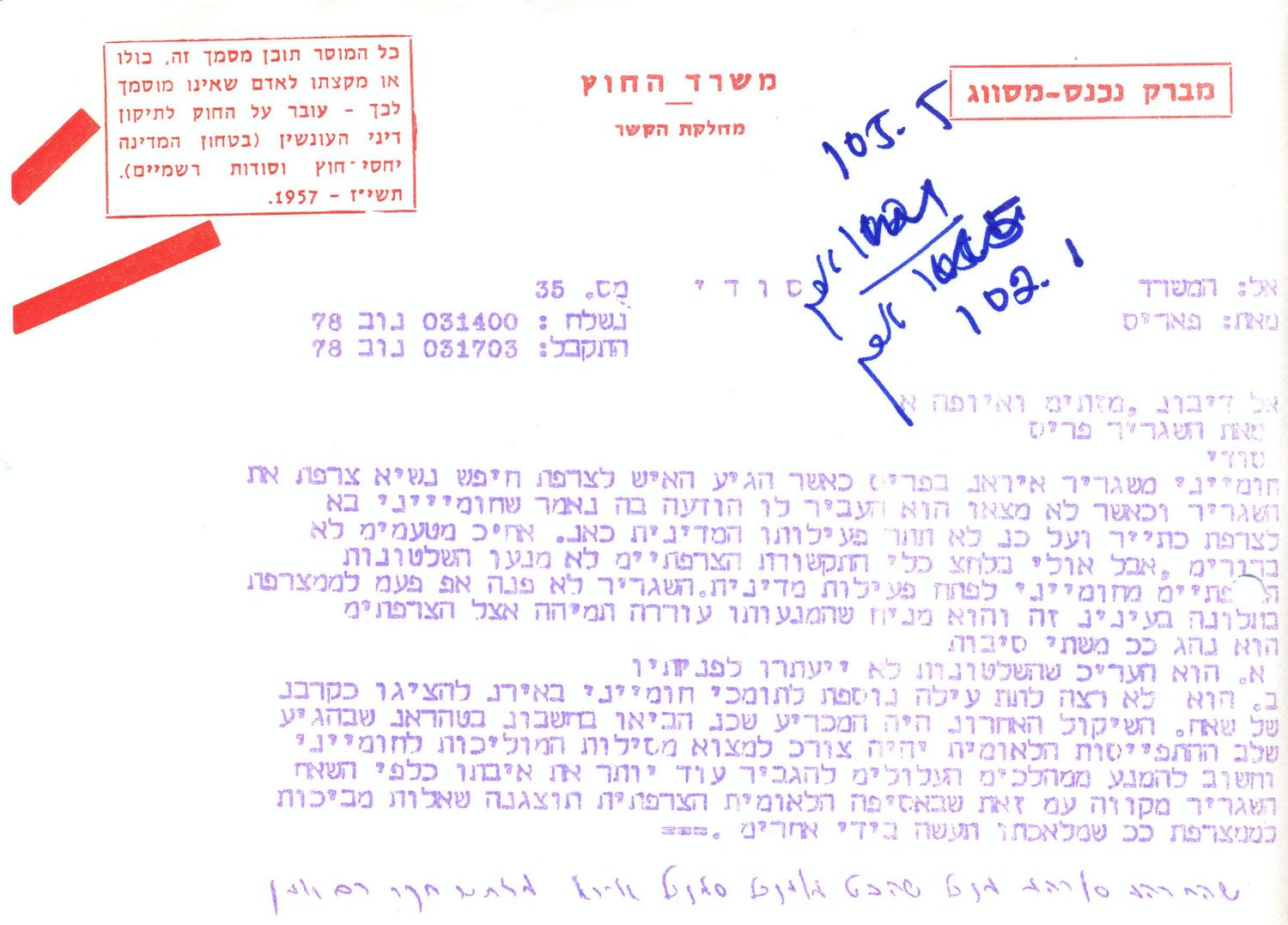
Scan: Israel State Archives, Item 0026hd7 ↗. Select the page to enlarge it.
What the document says
3 November 1978
“He came to France as a tourist”
According to the cable, when Ruhollah KhomeiniA Shiite cleric, leader of the Islamic Revolution in Iran; returned to Iran from exile in February 1979.More on Ruhollah Khomeini in “People and events” → arrived in France the French President sent the Iranian ambassador a message “that Khomeini had come to France as a tourist and therefore his political activity here would not be permitted”. Later, “for reasons that are unclear, but perhaps under pressure from the French media”, the authorities did not stop Khomeini from developing political activity (site translations).
3 November 1978
Why the Iranian ambassador kept silent
The Iranian ambassador had not complained to the French government, for two reasons. He judged that he would not be heeded, and he “did not want to give Ruhollah KhomeiniA Shiite cleric, leader of the Islamic Revolution in Iran; returned to Iran from exile in February 1979.More on Ruhollah Khomeini in “People and events” →’s supporters in Iran a further pretext to present him as Mohammad Reza Shah PahlaviThe Shah of Iran, 1941–1979; overthrown in the Islamic Revolution.More on Mohammad Reza Shah Pahlavi in “People and events” →’s victim”.
The second reason was the decisive one: in Tehran they reckoned “that when the stage of national reconciliation came, paths leading to Khomeini would have to be found” (site translations). Three months later, in February 1979, Khomeini returned to Iran.