
The Southern Periphery: Contacts with Sudan
In the mid-1950s Israel looked for ways to break the isolation imposed by its neighbours. One direction was Sudan, then approaching independence, whose leaders feared Egypt’s ambitions to dominate it. According to a study by the historians Elie Podeh and Andrew Felsenthal, Gazit, then first secretary at the Israeli embassy in London, was involved in the first phase of the secret contacts with members of Sudan’s Umma party. According to the study, on 17 June 1954 he and Michael Arnon met Sudanese representatives in London.
The contacts were meant to lay the groundwork for the southern tier of the “Periphery Alliance”, with Ethiopia and Sudan, against Nasser’s Egypt. According to the study, the British Foreign Office was not enthusiastic about an Israeli–Sudanese connection. The tie lasted until Sudan’s 1958 military coup, which ended it. It is an early appearance of something that would accompany Gazit throughout his career: quiet work in unofficial channels.[PF1]
Explore the sources and reading notes (1)
- [PF1] Elie Podeh and Andrew Felsenthal — Israel and Sudan: The Origins of Clandestine Relations (1954–1964) ↗
Israel Studies 28(2), 2023, pp. 1–28. A study of the two phases of secret contacts between Israel and Sudan, including Gazit’s role as first secretary in London in 1954.
Coordination on a Sensitive Issue
In spring 1961, Gazit was involved in discussions with the U.S. Department of State ahead of the first visit by American scientists to Dimona. The National Security Archive’s document collection describes his discussions about the timing of the visit and the arrangements for it.
State Department memoranda of conversation, held in the Wilson Center Digital Archive, trace the talks step by step. On 17 April 1961 Assistant Secretary Jones proposed to him that the visit be kept “quiet” rather than “secret”; on 1 May Deputy Assistant Secretary Armin Meyer discussed the visit with him; and on 16 May Philip Farley, the Secretary of State’s Special Assistant for Atomic Energy, reported a conversation with him about the visit and its purposes.
This was another aspect of his work as Minister at the embassy: attending to the practical details of a sensitive issue within the relationship between the Ben-Gurion and Kennedy administrations.[D12][WC1]
Explore the sources and reading notes (2)
- [D12] The First American Visit to Dimona ↗
National Security Archive, George Washington University. Introduction to a collection of documents about arrangements for the 1961 visit.
- [WC1] Wilson Center Digital Archive — documents on Mordechai Gazit ↗
Wilson Center, Washington. State Department memoranda of conversation from April–June 1961 on the American visit to Dimona, and a record of Gazit’s meeting with Victor Louis on 15 June 1973.
Security assurances and the Hawk talks
An American record places Gazit alongside Ambassador Avraham Harman in a February 1961 meeting where Israel’s request for Hawk missiles was discussed. In April 1962, he personally suggested a presidential letter assuring action against an Arab attack, coupled with Israeli restraint. Komer recorded this as Gazit’s own idea, not an authorised government proposal.
Hayim Iserovich’s historical article revisits Kennedy’s 1962 decision and cites Gazit’s telegram analysing its public disclosure. Gazit considered electoral timing while stressing professional advice and American national interests. His assessment looks beyond a single political explanation. These records illuminate his work in security diplomacy; they do not establish that he personally secured the sale.[D13][D14][D15][I2]
Everyday diplomacy in Washington: three documents
Explore the sources and reading notes (4)
- [D13] Harman and Gazit meet Bundy, 16 February 1961 ↗
FRUS, volume XVII, document 12. Gazit attended; the Hawk arguments are attributed to Ambassador Harman.
- [D14] Gazit’s conversation with Komer, 30 April 1962 ↗
FRUS, volume XVII, document 259. A personal suggestion concerning American security assurances; not an approved government proposal.
- [D15] Kennedy’s Hawk decision conveyed, 19 August 1962 ↗
FRUS, volume XVIII, document 24. Feldman reports conveying the decision to Ben-Gurion, Meir and Kollek; Gazit is not named as a participant.
- [I2] Hawks vs. Doves: The Story of the First US-Israel Arms Deal ↗
Hayim Iserovich, Israel Defense, 3 August 2018. the Gazit telegram it cites was not independently inspected.
Understanding the relationship with Iran
In a survey quoted by Eitay Mack, Gazit described Israel’s existing economic, military and intelligence ties with Iran as head of the Foreign Ministry’s Middle East Department. Mack places those ties within Israel’s support for the Shah’s dictatorship and awareness of repression. The survey records Gazit’s analytical work.
Historian Uri Bialer also cites this survey: Gazit to the Foreign Ministry, 23 February 1966, Israel State Archives 3998/6.
Read on2 more paragraphs
Raz Zimmt’s study records a conversation between Gazit and Iranian prime minister Amir-Abbas Hoveyda about the proposed Islamic alliance. It cites Gazit’s letter of 6 March 1966: the date of the report, rather than a separately verified meeting date.
More than a decade later, the Iranian crisis also reached his desk in Paris. Eldad Ben Aharon’s study identifies a dispatch from Gazit dated 30 November 1978, reporting on Khomeini’s arrival in France and continuing political propaganda. Together, these records illuminate two aspects of his work: interpreting regional relationships and reporting on them as they changed.[I1][I3][I4][I5][I6]
Explore the sources and reading notes (5)
- [I1] Eitay Mack — Israel and Iran under the Shah (Hebrew) ↗
Local Call, 17 June 2019.
- [I3] Eitay Mack — The unwritten history of Israel’s alliance with the Shah’s dictatorship ↗
+972 Magazine, 24 June 2019. I1 in English.
- [I4] Uri Bialer — Fuel Bridge across the Middle East: Israel, Iran, and the Eilat-Ashkelon Oil Pipeline ↗
2007 study. Checked p. 36, notes 12 and 22: Gazit to MFA, 23 February 1966, ISA 3998/6.
- [I5] Raz Zimmt — Iran and the Arab region ↗
INSS, 2024, p. 27, note 66. Indexed passage and reference to Gazit’s letter of 6 March 1966 checked.
- [I6] Eldad Ben Aharon — Israel–Iran relations and the 1979 revolution ↗
European Journal of International Security 9(1), 2024, p. 116, note 101. Passage and reference checked: Gazit’s Paris dispatch, 30 November 1978.
A confidential channel to Moscow
Yair Even’s study documents Gazit’s participation in secret talks with Soviet representatives, including Yevgeny Primakov, in Vienna in 1971 and 1973, and meetings with Victor Louis in Jerusalem. In March 1973, his instructions excluded opening negotiations over a settlement. Contacts resumed in April 1975. Even records Gazit’s involvement while criticizing Israeli assessments of Soviet intentions and warnings.
A record dated 15 June 1973, a week before the Nixon–Brezhnev summit, documents a meeting between Gazit, then Director-General of the Prime Minister’s Office, and the Soviet journalist Victor Louis. According to the archive’s description, they discussed the emigration of Jews from the Soviet Union and the low state of Israeli–Soviet relations.[S1][WC1]
Gazit’s own records in the Israel State Archives
Explore the sources and reading notes (2)
- [S1] Yair Even — Secret talks with Moscow ↗
Yesodot 5 (2023), PDF pp. 25–57.
- [WC1] Wilson Center Digital Archive — documents on Mordechai Gazit ↗
Wilson Center, Washington. State Department memoranda of conversation from April–June 1961 on the American visit to Dimona, and a record of Gazit’s meeting with Victor Louis on 15 June 1973.
Thinking about Jerusalem, with Teddy Kollek
Amnon Ramon’s study describes a group of senior government officials established by Teddy Kollek and chaired by Gazit. It discussed Meron Benvenisti’s July 1968 proposal for municipal boroughs in Jerusalem and its surrounding area, including local self-government. This records Gazit’s involvement in thinking about the city’s future.[J1]
Kollek was also a personal friend, as the family remembers; the Gazits lived for years in Jerusalem’s Wolfson neighbourhood. Family and home · Jerusalem, 1948
Explore the sources and reading notes (1)
- [J1] Amnon Ramon — Residents, Not Citizens ↗
With Yaël Ronen, Jerusalem Institute for Policy Research, 2017, p. 102, note 391. Relevant passage read; The July 1968 date refers to Benvenisti’s proposal.
Between Jerusalem and Washington: The War’s Final Days
In the last days of the Yom Kippur War and the week after, Gazit, as Director-General of the Prime Minister’s Office, stood at the Israeli end of the cable channel between Golda Meir’s office and the embassy in Washington. The cables of Ambassador Simcha Dinitz and Minister Mordechai Shalev were addressed to him, and through him the office sent out positions, instructions and reports. The historian Hagai Tsoref, who studied the cables opened to the public in 2022, traces this role day by day.
On 19 October, as it became clear that a ceasefire was near and Kissinger was about to fly to Moscow, Gazit set out Israel’s position in a cable to Dinitz: “It is vital in our view that this terrible war should not end merely in a dubious ceasefire. We are striving to enter negotiations and to achieve peace treaties” (in the site’s translation). According to Tsoref, this was the government’s position, and it held something new: a readiness to speak of full peace, not only of step-by-step arrangements. The next day he also reported to Dinitz on the developing oil crisis.
Read on2 more paragraphs
On 22 October Kissinger arrived directly from Moscow. After fifteen minutes alone with Golda Meir in Herzliya, Gazit and Kissinger’s aide Peter Rodman joined the conversation, and Gazit later reported to Dinitz on the talks. In the days that followed, as fighting continued despite the ceasefire and the United States demanded a return to the 22 October lines, the cables setting out Israel’s position went through him: the fighting was continuing because of Egyptian violations. On the morning of 24 October, as part of his regular reports, he updated Dinitz on the fronts so that he could brief the Americans. According to the State Archives’ account, he wrote that “in general, the night was quiet on the Egyptian front” (in the site’s translation), with similar conditions on the Syrian front. The fighting had not entirely stopped that day, and the wrangling over the ceasefire was only growing sharper.
On 29 October Dinitz relayed to him Kissinger’s message that President Nixon would be glad to receive the Prime Minister. The next day, in a single day of discussions, the leadership prepared for the visit, and Gazit summarised in a cable to Dinitz the six issues Israel would raise in Washington: supplies to the encircled Third Army, the exchange of prisoners and the lifting of the naval blockade, the IDF remaining on its current lines, Israel’s proposal for an exchange of territory, clarification of what had been promised to the Soviets, and continued arms supplies. These were the issues with which the talks at the White House opened on 1 November.[TZ1][ISA24]
Explore the sources and reading notes (2)
- [TZ1] Hagai Tsoref — “Golda Meir versus Kissinger: The Struggle over the Ceasefire Lines on the Egyptian Front” (Hebrew) ↗
Yesodot 5, IDF History Department, 2023. Based on the cables between the Prime Minister’s Office and the Washington embassy in the Israel State Archives, including Gazit’s cables to Dinitz of 19, 20, 22, 23 and 30 October 1973.
- [ISA24] Israel State Archives — “24 October 1973” (Hebrew) ↗
The State Archives’ account of the day, quoting Gazit’s cable to Dinitz, ול/9, file א־4996/5, p. 53. The line in the publication about a withdrawal of “300 or 200 metres” is Golda Meir’s.
Making sure the message was understood
During the ceasefire talks, Gazit clarified that an American message had arrived garbled. Here is the work of clarification, in the room.[D1]
“We did but it was garbled.”- The questionKissinger asks whether his message arrived.
- The clarificationGazit explains how Israel understood it.
- The workMaking a misunderstanding explicit, during a crisis.
Explore the sources and reading notes (1)
- [D1] Meir and Kissinger, 22 October 1973 ↗
FRUS, Volume XXV, Document 230. Memorandum.
The Jarring File: His Testimony in Retrospect
At the end of 1970, Golda Meir asked Foreign Minister Abba Eban that Gazit — then the Foreign Ministry’s deputy director-general for North American affairs — coordinate planning teams to prepare Israel for negotiations. That is how he described it in a 1987 interview with the Golda Meir Institute. According to him, the teams included Meir Shamgar on the treaty team, Aharon Yariv heading borders and security, Yaakov Herzog heading Jerusalem, and Moshe Sanbar heading refugee compensation. In those years, he said, “I was then in charge of the Jarring file” (in the site’s translation).
Gazit was sharply critical of the envoy’s method. In his view, the Swedish ambassador Gunnar Jarring was bound to fail because he worked at too low a level: he met neither Egypt’s President nor Israel’s Prime Minister and settled for exchanges of documents, while continuing to serve as his country’s ambassador in Moscow. Gazit proposed bringing Jarring to Jerusalem to talk with Golda Meir, which happened in January 1971. He also proposed a more flexible draft of Israel’s reply; it was rejected by Meir, by Eban and by the Foreign Ministry’s Director-General, Gideon Rafael. He said he warned Eban that the word “agreed”, in “secure, recognised and agreed boundaries”, would be read in Cairo as a territorial claim and rejected.
Read on2 more paragraphs
The interview took place amid a public debate — prompted in part by Yossi Beilin’s writing — over whether Golda Meir had missed a chance for peace in 1971. Gazit disputed the claim sharply. In his view, Egypt’s reply to Jarring included conditions, among them the refugee question, that broke the rules the envoy himself had set; the UN report did not blame the failure on Israel’s reply; and the statement that Israel would not return to the June 1967 lines reflected a cabinet decision and a position that predated Meir. He also recounted that in August 1970, when Egypt moved its missile batteries towards the canal as the ceasefire took effect, Moshe Dayan pressed to resume fighting, and Meir refused.
He described Arab diplomacy in those years as “diplomacy by automation”: holding to a fixed formula, without real negotiation. These are his words and his interpretation sixteen years later, from the vantage point of someone who took part in the events and in the arguments around them. The full transcript, with its context and its blunt phrasing, is open at the Golda Meir Institute.[H2]
Explore the sources and reading notes (1)
- [H2] Interview with Mordechai Gazit — Golda Meir Institute ↗
17 December 1987, according to the archive catalogue. Interviewers: Sarah Rahavi and Judith Reifen-Ronen. An openly accessible Hebrew transcript.
Facing the American Embassy
In the years between the Six-Day War and the Yom Kippur War, Gazit was one of the American embassy’s points of contact in the Israeli government. Two telegrams published in the FRUS series show this quiet work: receiving positions, clarifying them, and protecting Israel’s interest in the details of procedure.
On 26 August 1970, a few weeks after the ceasefire that ended the War of Attrition, the embassy’s deputy chief of mission presented Washington’s position to him: Egypt was not entitled to move missile batteries within the standstill zone. In the same conversation he conveyed Egypt’s allegations of Israeli violations, suggesting they be passed to the military authorities for consideration.
On 23 April 1971, days after Golda Meir handed the Americans Israel’s proposal for a Suez Canal arrangement, a written American reply arrived. Gazit gave the U.S. official a short, precise statement: Israel would discuss the matter with the Ambassador the following week, and asked that no document be delivered to Egypt. It is an example of a hand setting the pace — not allowing an unagreed text to go out into the world.[FR70][FR71B]
Explore the sources and reading notes (2)
- [FR70] FRUS — Ceasefire violations, August 1970 ↗
FRUS, Volume XXIII, Document 154, footnote 5. The U.S. deputy chief of mission presents the U.S. position on the military standstill to Gazit on 26 August 1970.
- [FR71B] FRUS — Israel’s Suez Canal proposal, April 1971 ↗
FRUS, Volume XXIII, Document 224, footnote 6. Gazit’s statement to the U.S. official on 23 April 1971.
A near-verbatim record
In October 1971 the United States sought to move Israel and Egypt toward negotiations on an interim Suez Canal agreement, without asking either side to change its positions in advance. The U.S. chargé d’affaires presented the idea to Foreign Minister Abba Eban, and Gazit accompanied him to the meeting.
According to the American telegram, Gazit took down the presentation practically verbatim. Before the meeting he had gone over Yitzhak Rabin’s report from Washington on his talk with Joseph Sisco with the American diplomat, and at the end he added that Murad Ghaleb, mentioned as a possible Egyptian representative, was already known to be coming to New York for the UN General Assembly.[FR71]
Explore the sources and reading notes (1)
- [FR71] Eban and the U.S. chargé, 21 October 1971 ↗
FRUS 1969–1976, Volume XXIII, Document 261. Telegram from the U.S. Embassy in Israel.
Words That Shape an Agreement
After the war, Gazit took part in talks in Washington alongside Golda Meir. The discussion concerned supplies for Egyptian forces, military lines and the possibility of moving towards an agreement. He suggested emphasizing direct talks between the generals, considered alternative wording for redeployment and raised the issue of the wounded.
The record shows professional work that is not always visible in an official photograph: listening to an argument, proposing a different term and bringing an important issue back to the agenda.
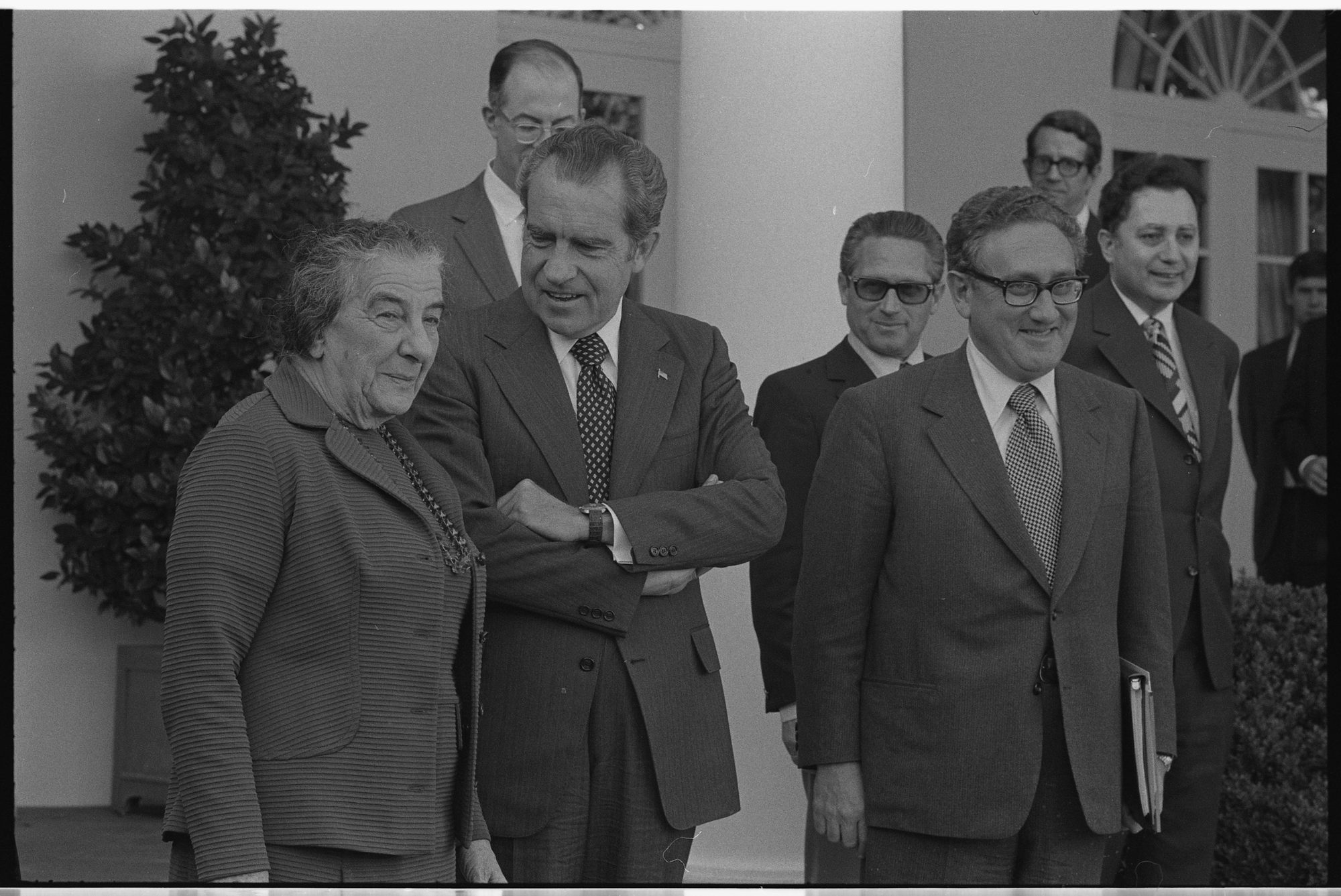
The same day, Gazit went into the Oval Office with Golda Meir, Ambassador Simcha Dinitz and General Aharon Yariv for a meeting with President Richard Nixon and Kissinger. Meir thanked the President for the airlift and spoke of the prisoners and of the war’s toll. Nixon described the decisions he had taken during the war and urged her to make the most of the direct talks that had opened between the generals. At the end, the President walked the Prime Minister to the Rose Garden steps for photographs.[D2][FR73N]
Explore the sources and reading notes (2)
- [D2] The Washington Talks, 1 November 1973 ↗
FRUS, Volume XXV, Document 305. Gazit participates in a discussion of direct talks, redeployment and prisoners of war.
- [FR73N] FRUS — Golda Meir with President Nixon, November 1973 ↗
FRUS, Volume XXV, Document 306. The Oval Office. Gazit is listed among the participants as head of the Prime Minister’s Office.
The practical questions
In December 1973, as the Geneva Conference was being convened, Henry Kissinger briefed Golda Meir and her ministers at the Prime Minister’s Office on Sadat’s ideas for disengagement in Sinai. Gazit, of the Prime Minister’s Office, was among the Israeli participants, alongside Allon, Eban, Dayan, Dinitz, Elazar and Yariv.
The memorandum records two questions he raised: whether there would be an inspection arrangement, and what the distances and depth of the belts separating the forces would be. These practical questions stood at the heart of the discussion on disengagement.[FR73]
Explore the sources and reading notes (1)
- [FR73] Meir and Kissinger on disengagement, December 1973 ↗
FRUS 1969–1976, Volume XXV, Document 401. Memorandum of conversation at the Prime Minister’s Office.
Between the Hot Soup and the Next Draft
One of the more human scenes in the records begins at a working lunch. Yigal Allon suggested getting down to business because the soup was very hot; around the table, the participants discussed disengagement. Later, he remarked that Gazit was still revising the draft, and referred further changes in wording to him.
Alongside the political disagreements, the memorandum also preserves jokes and laughter. Matters of state moved forward through a human encounter, with a constant exchange between political principles and the words that would appear in the document.
A few days before the disengagement agreement was signed on 18 January 1974, Kissinger and the Israeli team went over the final drafts in the Prime Minister’s office. Handed a long list of points for his meeting with Sadat, Kissinger called it “commentary and exegesis” and asked for a simple checklist. He sent Gazit and Harold Saunders of the National Security Council into the next room to draw up an agreed one. When they returned, Kissinger went through the new list item by item, and Gazit added context to a point the Chief of Staff had raised the night before.[D3][FR74B]
Kissinger: This is a commentary and exegesis. Can someone do a simple checklist? Let Hal and Gazit get together in the next room and do an agreed checklist. [Mr. Saunders and Mr. Gazit go out.]
Kissinger: [goes over the new checklist prepared by Gazit and Saunders, reads the items] — sea minefield map.
Gazit: This was mentioned by the Chief of Staff last night.
Kissinger: This he won’t agree to.
Explore the sources and reading notes (2)
- [D3] Discussion of Disengagement, 15 January 1974 ↗
FRUS, Volume XXVI, Document 6. Gazit works on the wording of the draft during a working lunch in Jerusalem.
- [FR74B] FRUS — The final drafts before the disengagement agreement, January 1974 ↗
FRUS, Volume XXVI, Document 7. Prime Minister’s office, Jerusalem. Kissinger sends Gazit and Saunders to draft an agreed checklist for the meeting with Sadat.
Toward the decision on the Syrian agreement
On 28 May 1974 Kissinger returned from Damascus and reported at the Prime Minister’s Office on the final stage of the disengagement negotiations with Syria. Gazit, listed in the memorandum as Director of the Prime Minister’s Office, took part alongside Golda Meir, Prime Minister-designate Yitzhak Rabin, Yigal Allon, Abba Eban, Moshe Dayan and Shimon Peres.
The discussion covered the separation line, the Mount Hermon area, the UN observer force and the wording of the American assurance on attacks across the line. It ended with the drafts being taken to the Cabinet for a decision.[FR74]
Explore the sources and reading notes (1)
- [FR74] The agreement with Syria, 28 May 1974 ↗
FRUS 1969–1976, Volume XXVI, Document 76. Memorandum of conversation at the Prime Minister’s Office.
Continuity in Service, Alongside Rabin
When Yitzhak Rabin became prime minister, Gazit continued as Director-General of the Prime Minister’s Office. His role is explicitly recorded in the list of participants at the Rabin–Ford meeting on 10 September 1974. The discussion concerned disengagement agreements and Israel’s security needs.
In June 1975, he again took part in talks with Ford and Kissinger. This time, the participants considered options for an interim agreement and the limits of diplomatic flexibility. His presence in both records documents the continuity of his work at the senior professional level.
Read on4 more paragraphs
The original memorandum of the 11 June 1975 meeting, held at the Gerald R. Ford Presidential Library, records two hours of conversation in the Oval Office. Beside Rabin sat Ambassador Simcha Dinitz, Gazit and Mordechai Shalev of the embassy; across from them were President Ford, Kissinger, Joseph Sisco and Brent Scowcroft. Ford opened by stating plainly his disappointment over the stalemate in March, and Rabin set out Israel’s case for an interim agreement with Egypt.
When Kissinger asked how many settlements on the Golan Heights would be affected by a withdrawal of even three kilometres, the memorandum records Gazit’s answer: “At least half. About six or seven.” It is an example of his role in the room — supplying the precise figure at the moment a question turned from principle to practice.
The White House’s ceremonial papers preserved his presence, too. For the state dinner in Rabin’s honour in September 1974, each guest had a place card and a pronunciation guide; his read gah-ZEET. The Naval Photographic Center’s film catalogue lists Gazit among those present on reels from 12 June 1975, which recorded Rabin’s arrival at the White House and the toasts.
The White House photo logs also list him by name. On 12 September 1974 he is among those photographed in the Cabinet Room, and in colour photographs of the meeting by the fireplace in the Oval Office. On 12 June 1975 he is listed again, at the Oval Office meeting and at the farewell on the walkway to the delegation’s cars. According to the Ford Library, White House photographers’ pictures are in the public domain, and scans can be ordered by roll and frame number.[D4][D5][FD1][FD4][FD5][FD8][FD9]
White House photographers’ contact sheets, 1974–1975
Secretary Kissinger: Even three kilometers? How many settlements would you have to move?
Minister Gazit: At least half. About six or seven.
The memorandum labels the speaker “Minister Gazit”, although Gazit was then Director-General of the Prime Minister’s Office. Open the scanned document ↗
Explore the sources and reading notes (7)
- [D4] Rabin and Ford at the White House, 10 September 1974 ↗
FRUS, Volume XXVI, Document 99. Gazit is listed as Director-General of the Prime Minister’s Office; no statement is attributed to him in this memorandum.
- [D5] Rabin and Ford, 11 June 1975 ↗
FRUS, Volume XXVI, Document 183. A working meeting attended by Gazit ahead of further talks on an interim agreement.
- [FD1] The original memorandum: Rabin and Ford in the Oval Office, 11 June 1975 ↗
Gerald R. Ford Presidential Library, National Security Adviser’s Memoranda of Conversation. Scan of the full memorandum (15 pages), including the list of participants and Gazit’s answer on the Golan settlements.
- [FD4] State dinner for Prime Minister Rabin, September 1974 — seating guidance ↗
Gerald R. Ford Presidential Library. Guest list and place cards with a pronunciation guide for each guest; for Gazit: gah-ZEET.
- [FD5] Naval Photographic Center film catalogue ↗
Gerald R. Ford Presidential Library. Reels from 12 June 1975: Rabin’s arrival at the White House and the toasts; Gazit is on the list of those present.
- [FD8] White House photo log, 12 September 1974 ↗
Gerald R. Ford Presidential Library. Gazit is listed on rolls A0722 (27–30), A0723 (6–29, colour), A0724 (3–14, colour) and A0728.
- [FD9] White House photo log, 12 June 1975 ↗
Gerald R. Ford Presidential Library. Gazit is listed on rolls A5019 (22A–26A), A5025 (4–10) and A5028 (10–12). The photographs are in the public domain.
“Too Sensible”: In Kissinger’s Shuttle
In March 1975, Henry Kissinger shuttled between Jerusalem and Aswan in pursuit of a second interim agreement between Israel and Egypt. Gazit sat on the Israeli negotiating team alongside Rabin, Yigal Allon, Shimon Peres, Ambassador Simcha Dinitz, Chief of Staff Mordechai Gur and Foreign Ministry Director-General Avraham Kidron. The memoranda of those meetings, held at the Gerald R. Ford Presidential Library, show him as the keeper of the texts and the facts.
On the morning of 19 March, at the Prime Minister’s Residence, Rabin opened with a question: “Do we have all the formulations, Gazit?” — “Yes, we have it,” he replied. When Dinitz mentioned President Nixon’s letter, Gazit supplied the date at once: July 1971. At the same meeting Kissinger recounted telling Egypt’s Foreign Minister, Ismail Fahmy, that Gazit could draft the clause; Fahmy, he said, replied that Gazit was “too sensible” and that it had to be the legal adviser, Meir Rosenne. The room laughed. Sisco told Gazit it was a real compliment, and Allon added that when you get a compliment from Fahmy, you had better think again.
Read on3 more paragraphs
Other memoranda from the same round record the same role. When Kissinger asked whether the armistice agreements had lasted 19 years, Gazit corrected him: “Eighteen.” When Rabin said he was not offering a legal formula, Kissinger replied: “Gazit will do that.” And when the discussion turned to how to announce the suspension of the talks, he advised that it be done in person. Gazit also sat in the final meeting, on the evening of 22 March in the Prime Minister’s office, where the shuttle was suspended. The memorandum records that as the group rose from the table, one of those present said: “It is a Greek tragedy.” Kissinger replied that this was what made it worse — each side, following the laws of its own nature, had reached an outcome that was perfectly foreseeable. Talks resumed that summer and led to the interim agreement signed in September.
Two more memoranda from the same round show his work up close. On 14 March, when Kissinger reported that Sadat was willing to let American firms in despite the Arab boycott, Gazit noted that it would be on a selective basis only: “Because out of 20, he could admit only two. The blacklist remains.” At the same meeting, having given up on agreeing language with Fahmy for the clause on renewing the UN force, Kissinger said: “Maybe Gazit can work out something.”
On 20 March — the morning Kissinger read to the Israeli team the stern statement on a “reassessment” of U.S. policy — Gazit handed Allon the draft of the non-use-of-force clause. When Kissinger remarked that the phrase “in the relations between themselves” had provoked an uproar from Fahmy, Gazit answered: “No. Take it out.” At the end of the discussion Rabin asked: “Let Gazit and Simcha work to prepare ourselves for the Cabinet meeting.” By the evening meeting, a revised text was on the table.[FD2][FD3][FR75][FD6][FD7]
Kissinger: On the boycott, he IS prepared to change the boycott. […] But he will let American firms in.
Gazit: On a selective basis.
Sisco: Correct.
Gazit: That is not so good. Not so very good.
Kissinger: Why?
Gazit: Because out of 20, he could admit only two. The blacklist remains.
Rabin: Do we have all the formulations, Gazit?
Gazit: Yes, we have it.
Kissinger: Fahmy said this has to be drafted by Rosenne. I said Gazit could have done it. He said no, Gazit is too sensible; it has to be Rosenne. [Laughter]
Sisco: [to Gazit] You have a real compliment.
Allon: [to Gazit] When you get a compliment from Fahmy, you’d better think again. [Laughter]
Kissinger: The phrase "in the relations between themselves" produced an uproar from Fahmy.
Allon: Wasn’t that in there before?
Gazit: No. Take it out.
Rabin: Let Gazit and Simcha work to prepare ourselves for the Cabinet meeting.
Explore the sources and reading notes (5)
- [FD2] Memorandum of conversation: Kissinger and the Israeli negotiating team, 19 March 1975 ↗
Gerald R. Ford Presidential Library, Kissinger Reports, Box 4, Kissinger’s trip, March 1975. Prime Minister’s Residence, Jerusalem, 8:45–10:20 a.m. Includes the exchanges on the formulations, the Nixon letter and “too sensible”.
- [FD3] Gerald R. Ford Presidential Library — search results for “Gazit” ↗
44 items: memoranda from Kissinger’s March 1975 shuttle, papers from the September 1974 state dinner, contact sheets, the President’s Daily Diary and a film catalogue. Quoted excerpts rely on the library’s text recognition of the scans.
- [FR75] FRUS — The final meeting of the shuttle, 22 March 1975 ↗
FRUS, Volume XXVI, Document 158. Jerusalem, 6:35–8:15 p.m. Gazit is on the list of participants; the memorandum records the decision to suspend the talks.
- [FD6] Memorandum of conversation: Kissinger and the negotiating team, 14 March 1975 ↗
Gerald R. Ford Presidential Library. Prime Minister’s office, Jerusalem, 1:10–3:45 p.m. Gazit’s remark on the boycott: p. 10 of the document (p. 12 of the file).
- [FD7] Memorandum of conversation: Kissinger and the negotiating team, 20 March 1975 ↗
Gerald R. Ford Presidential Library. Prime Minister’s office, Jerusalem, 9:50 a.m.–12:35 p.m., and an evening meeting, 5:30–6:45 p.m. The non-use-of-force drafting and Rabin’s request: pp. 19–21 of the document.
Turning Agreement into Action
On 4 September 1975, Gazit signed the interim agreement between Israel and Egypt in Geneva, alongside Major General Herzl Shafir. The list of signatories is preserved in the Security Council’s records, and the UN Secretary-General’s report of that day confirms the signing date.
A diplomatic agreement also needs maps, schedules and instructions for implementation. According to the UN Secretary-General’s report, the military working group concluded its discussions on 22 September, when Gazit and Herzl Shafir initialled the implementation protocol and maps on Israel’s behalf. Taha el-Magdoub signed for Egypt.
This directly documents his responsibility during the implementation stage of the interim agreement. The agreement, its implementation protocol and the peace treaty signed in 1979 are distinct documents.[D11][D6]
Watch: the signing ceremony in Geneva, 1975
Explore the sources and reading notes (2)
- [D11] The Interim Agreement — UN Security Council Official Records ↗
S/11818/Add.1–2, September 1975. The signatories and report of the signing in Geneva on 4 September. The UN distinguishes the text dated 1 September from the signing ceremony.
- [D6] Report of the UN Secretary-General, S/11818/Add.4 ↗
23 September 1975. Records Gazit and Herzl Shafir initialling the implementation protocol and maps on 22 September.
Representing, Protesting — and Continuing the Conversation
During the Entebbe hostage crisis in July 1976, Gazit represented Israel in contacts with the French government. Contemporary JTA reporting records that he conveyed Israel’s request for negotiations to secure the hostages’ release, including discussion of releasing prisoners. This documents his part in the diplomatic channel operating during the crisis.
His time in France included the crisis following Abu Daoud’s release in 1977. Gazit was recalled to Israel for consultations, and after returning to Paris he met Foreign Minister Louis de Guiringaud. JTA reported that they agreed to review the extradition treaty between the two countries.
Read on2 more paragraphs
Fuel supplies for Iraq’s reactor were another sensitive issue. Peter Ford’s study describes Gazit’s approaches to France in 1977–1978: requests for alternative fuel and delayed delivery pending testing. This is later research drawing on Shlomo Nakdimon’s book.
In its farewell report in July 1979, Le Monde praised his courtesy and the French he had learned. This is the contemporary newspaper’s impression.[D16][D7][D17][D8]
Watch: Gazit and the press in the Abu Daoud affair, 1977
Explore six more moments in Paris
Explore the sources and reading notes (4)
- [D16] JTA — France begins negotiating for Israel ↗
2 July 1976. identifies Gazit’s message to the French Foreign Ministry.
- [D7] Israel, France Examining Relations in Aftermath of Abu Daoud Affair ↗
JTA, 8 February 1977. Gazit’s return to Paris and his meeting with the French foreign minister following the crisis.
- [D17] Peter S. Ford — Diplomacy over Iraq’s reactor ↗
USAF INSS, 2005, printed pp. 16–17, note 23. the underlying source is Shlomo Nakdimon’s First Strike.
- [D8] Farewell to Israel’s Ambassador to France ↗
Le Monde, 5 July 1979. A contemporary farewell report.
Who’s who in these pages14
Roles are given as they were at the time. Links lead to the moments where each person appears.
- Golda Meir
- Prime Minister, 1969–1974. Gazit headed her office.The Jarring file, 1970–1971The war’s final days, 1973Words that shape a settlement, 1973
- Yitzhak Rabin
- Prime Minister, 1974–1977; earlier Deputy Chief of Staff and ambassador in Washington.Alongside Rabin at the White House, 1974–1975“Too sensible”, 1975
- Yigal Allon
- Deputy Prime Minister, and Foreign Minister in Rabin’s government.The decision on the Syrian agreement, 1974“Too sensible”, 1975
- Abba Eban
- Foreign Minister, 1966–1974.Taken down almost word for word, 1971The Jarring file, 1970–1971
- Simcha Dinitz
- Israel’s ambassador in Washington from 1973.The war’s final days, 1973Words that shape a settlement, 1973“Too sensible”, 1975
- Aharon Yariv
- Major General, former head of Military Intelligence and adviser to the Prime Minister.Words that shape a settlement, 1973
- Meir Rosenne
- Legal adviser to the Foreign Ministry.“Too sensible”, 1975
- Henry Kissinger
- U.S. National Security Adviser and Secretary of State.Making sure the message was understood, 1973Between the hot soup and the next draft, 1974“Too sensible”, 1975
- Joseph Sisco
- Assistant Secretary of State for Near Eastern Affairs.“Too sensible”, 1975
- Harold Saunders
- U.S. National Security Council staff.Between the hot soup and the next draft, 1974
- Ismail Fahmy
- Egypt’s Foreign Minister.“Too sensible”, 1975
- Anwar Sadat
- President of Egypt, 1970–1981.Taken down almost word for word, 1971The interim agreement, 1975
- Richard Nixon
- President of the United States, 1969–1974.Words that shape a settlement, 1973
- Gerald Ford
- President of the United States, 1974–1977.Alongside Rabin at the White House, 1974–1975