
The file of staff papers of a senior team set up on the eve of the Geneva Conference, in December 1973. Two letters over his handwritten signature, to the Prime Ministers Golda Meir and Yitzhak Rabin, tell what the team did, who sat on it, and why it should be reconvened.
Two pages from the file
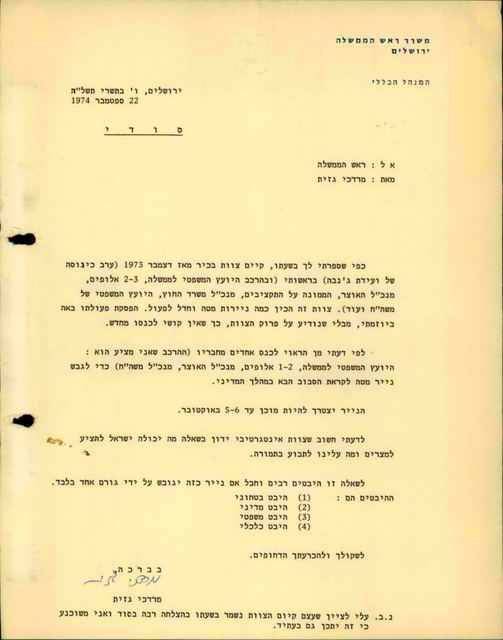
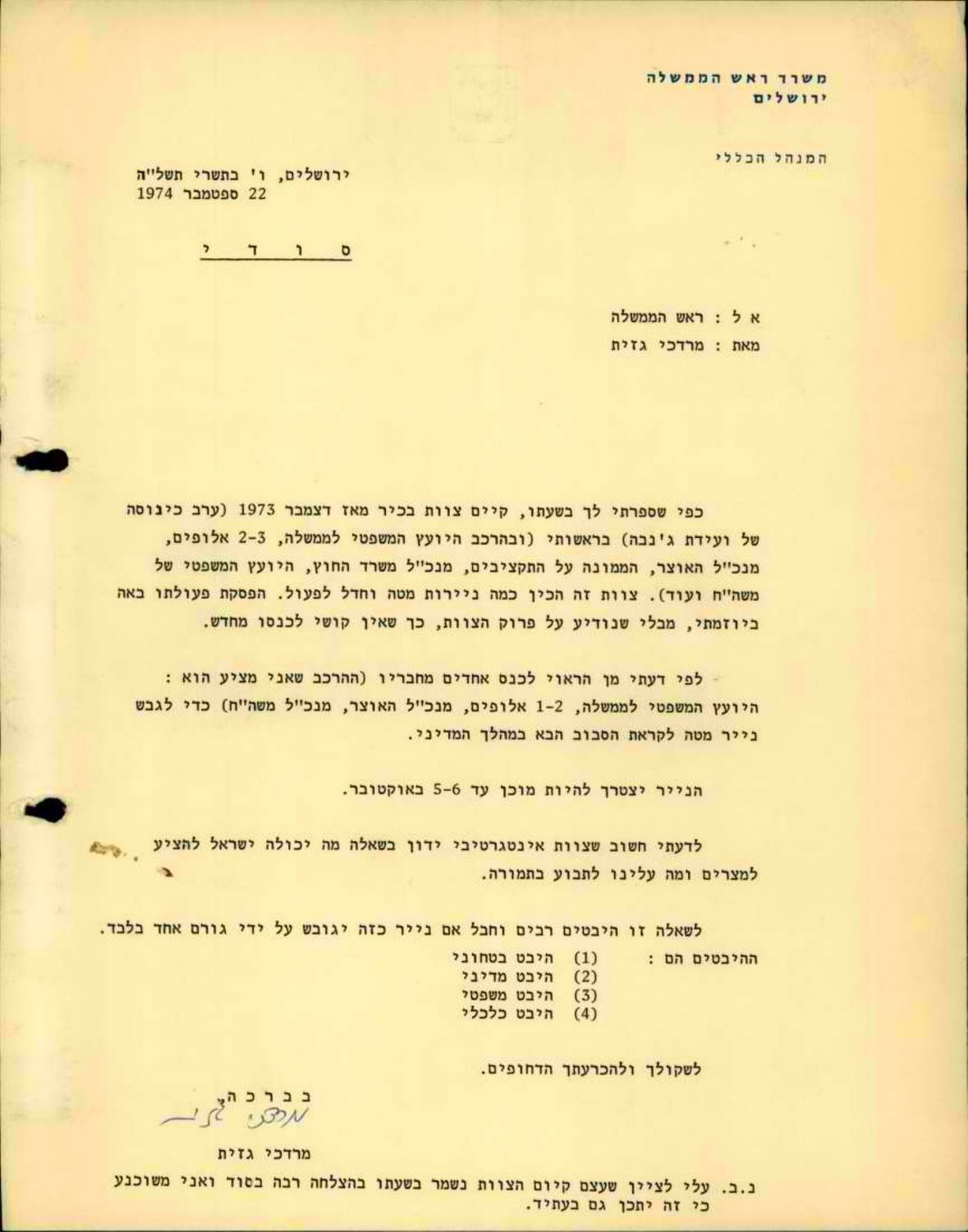
22 September 1974: “A senior team has existed since December 1973”, the letter to the Prime Minister, over his signature 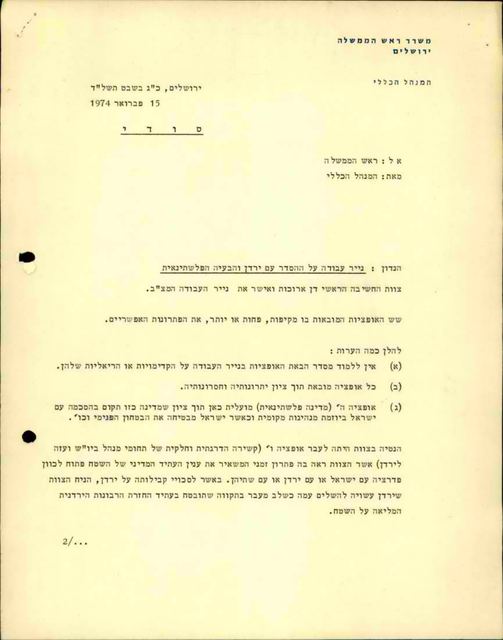
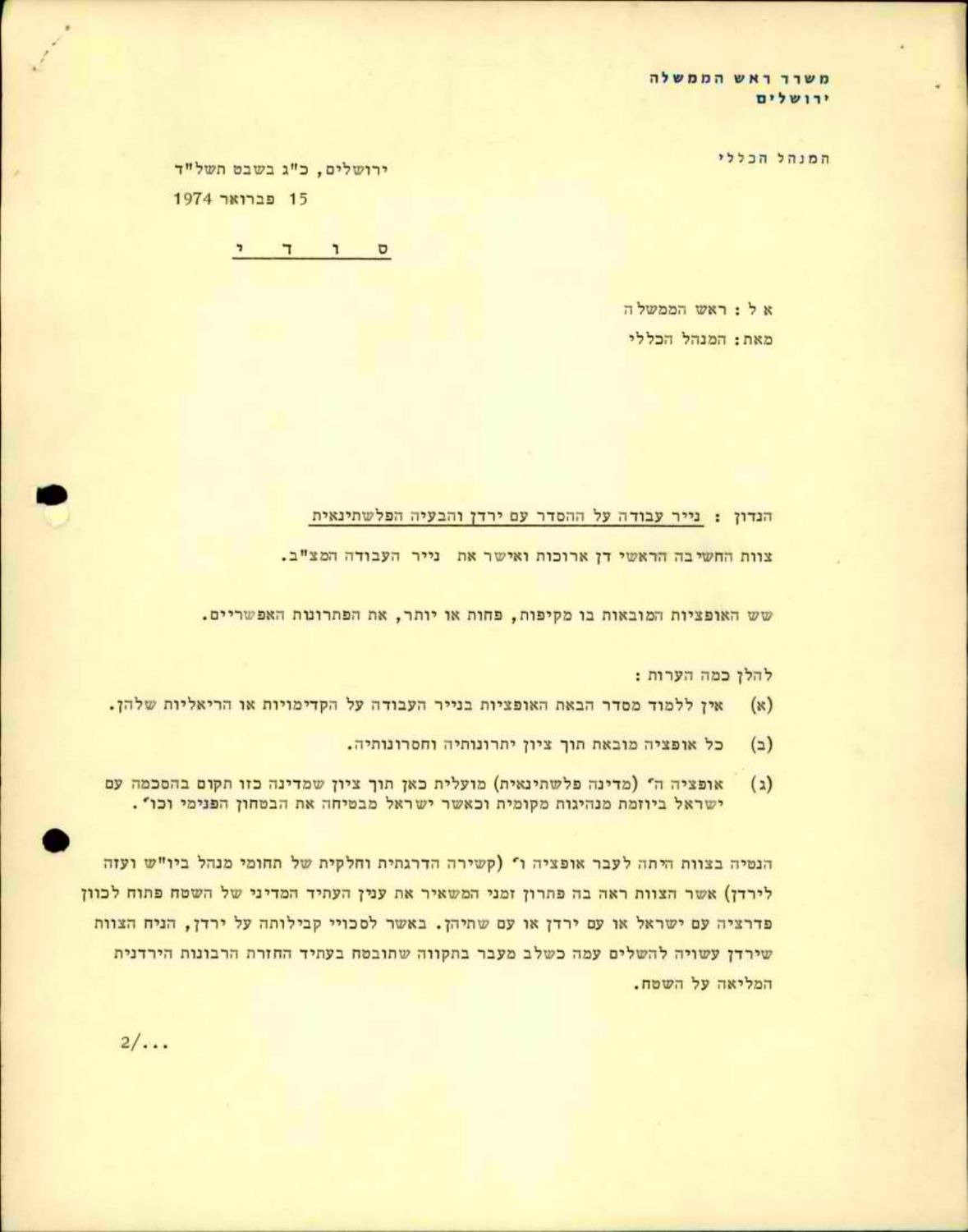
15 February 1974: “A working paper on the settlement with Jordan and the Palestinian problem”, the first page
Scans: Israel State Archives, file HZ-5977/7 ↗. Two pages of the file’s 166 are shown here; the file itself is kept at the Archives.
What the file shows, in the words on the page
27 May 1971
“Walking a tightrope”: an evening with the IDF’s planners
The earliest paper in the file: an eleven-page record of a discussion in the bureau of the Assistant Chief of the General Staff Branch for planning, “with Mr Mordechai Gazit, Deputy Director-General of the Foreign Ministry, on the evening of 27.5.71”. The subject: the global policy of the United States, and what follows from it for Israel.
According to the record he said: “The United States is suffering from war-weariness. So whatever the American government does today, it does cautiously, like someone walking a tightrope. This flexible policy they call the ‘Richard NixonPresident of the United States, 1969–1974.What they wanted: Stability in the Middle East and a check on Soviet influence, without a direct clash between the powers.More on Richard Nixon in “People and events” → Doctrine’” (site translation). The war is the Vietnam War. The record was made by someone else, and the handwritten corrections are not given here.
15 February 1974
Six options for Jordan and the Palestinian question
A letter marked “secret” to the Prime Minister, Golda MeirPrime Minister, 1969–1974. Gazit headed her office twice: when she was Foreign Minister in the late 1950s, and as Director-General of the Prime Minister’s Office from 1973.What they wanted: Security for Israel, and peace through direct negotiation, without a return to the 1967 lines.More on Golda Meir in “People and events” →, over his handwritten signature, with a working paper attached: “The main think-team discussed at length and approved the attached working paper. The six options set out in it cover, more or less, the possible solutions.”
He warns that “nothing should be inferred from the order of the options in the working paper as to their priority or their realism”, and reports where the team leaned: “towards option F (a gradual and partial linking of fields of administration in Judea, Samaria and Gaza to Jordan), which the team saw as a temporary solution that leaves the question of the political future of the territory open”.
And at the end he asked for a decision: “I would be grateful if you would indicate which of the options mentioned in the attached it is desirable to begin working out” (site translations). On 23 June 1974 he sent the paper to the Foreign Minister as well.
22 September 1974
“Was kept secret at the time with great success”
A letter marked “secret” to the Prime Minister, then Yitzhak RabinPrime Minister, 1974–1977; earlier Deputy Chief of Staff and ambassador in Washington.What they wanted: To move step by step, through interim agreements, in return for American guarantees and arms.More on Yitzhak Rabin in “People and events” →, over his handwritten signature: “As I told you at the time, a senior team has existed since December 1973 (the eve of the convening of the Geneva Conference) under my chairmanship (composed of the Attorney-General, two or three generals, the Director-General of the Treasury, the Budget Director, the Director-General of the Foreign Ministry, the Foreign Ministry’s Legal Adviser and others). This team prepared several staff papers and ceased to operate. Its work was stopped on my initiative, without our announcing that the team was disbanded, so there is no difficulty in reconvening it.”
He proposes convening some of its members before the next round, on the question of what Israel can offer Egypt and what it should demand in return, and gives his reason: “This question has many aspects, and it would be a pity if such a paper were drawn up by one body alone.”
And in a postscript: “I should note that the very existence of the team was kept secret at the time with great success, and I am convinced that this is possible in future too” (site translations).