
A Foreign Ministry file that bears his name. It holds the records of the Prime Minister’s talks in Washington in the first days of November 1973, with President Nixon and with Kissinger, and the analysis Gazit wrote as the visit ended.
Scan: Israel State Archives, file HZ-5973/5 ↗. One page of the file’s 114 is shown here; the file itself is kept at the Archives.
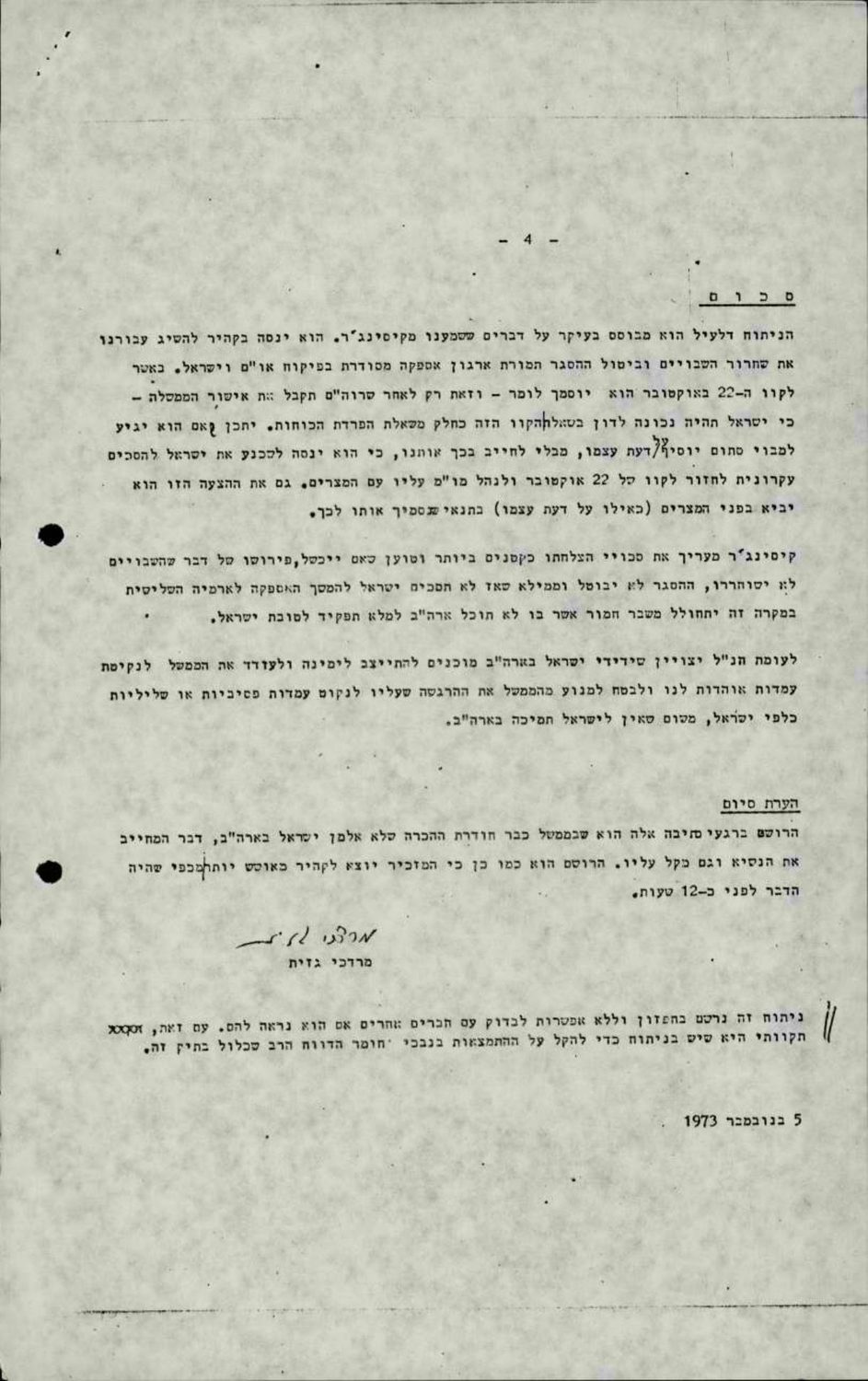
What the file shows, in the words on the page
1 November 1973
In the room with Nixon
The Hebrew record of Golda MeirPrime Minister, 1969–1974. Gazit headed her office twice: when she was Foreign Minister in the late 1950s, and as Director-General of the Prime Minister’s Office from 1973.What they wanted: Security for Israel, and peace through direct negotiation, without a return to the 1967 lines.More on Golda Meir in “People and events” →’s meeting with President Richard NixonPresident of the United States, 1969–1974.What they wanted: Stability in the Middle East and a check on Soviet influence, without a direct clash between the powers.More on Richard Nixon in “People and events” →, marked top secret, lists those present: the Secretary of State, Ambassador Simcha DinitzIsrael’s ambassador in Washington from 1973.What they wanted: American arms and support, during the war and after it.More on Simcha Dinitz in “People and events” →, Aharon YarivMajor General, former head of Military Intelligence and adviser to the Prime Minister.What they wanted: To use the ceasefire for direct military talks with Egypt, at Kilometre 101.More on Aharon Yariv in “People and events” →, Mordechai Gazit and Hal Saunders. “The conversation began at 12.10 and ended at 13.50” (site translation). The record, fourteen pages long, ends with his handwritten signature.
5 November 1973
“Points for a summary”: an analysis in four pages
As the visit ended he set down what it had taught, subject by subject: the Soviet Union, the United States, Egypt. “The weakness of the United States has two causes”, he wrote. One was temporary: “the terrible weakness of the presidency and the total crisis of confidence that marks relations between the President and the people”.
The other: “its shortage of vital military items”. Of Egypt he wrote: “Cairo has never despaired of the United States as an important means of achieving its aims.” And in his closing note: “The impression at the moment of writing is that the Administration is already coming to recognise that Israel is not forsaken in the United States” (site translations).
5 November 1973
The reservation beneath the signature
Beneath his signature he added a line on the limits of his own analysis: “This analysis was written in haste and with no chance to check with other colleagues whether it seems right to them. Even so, I hope it will make it easier to find one’s way through the mass of reporting contained in this file” (site translation).