
The file of incoming cables to his office, from 1 January to 10 February 1974, the weeks of the disengagement agreement with Egypt. Most of the cables in it, from Ambassador Simcha Dinitz and Minister Mordechai Shalev in Washington, are headed “To: Gazit – addressee only”.
Scan: Israel State Archives, file A-7060/7 ↗. One page of the file’s 259 is shown here; the file itself is kept at the Archives.
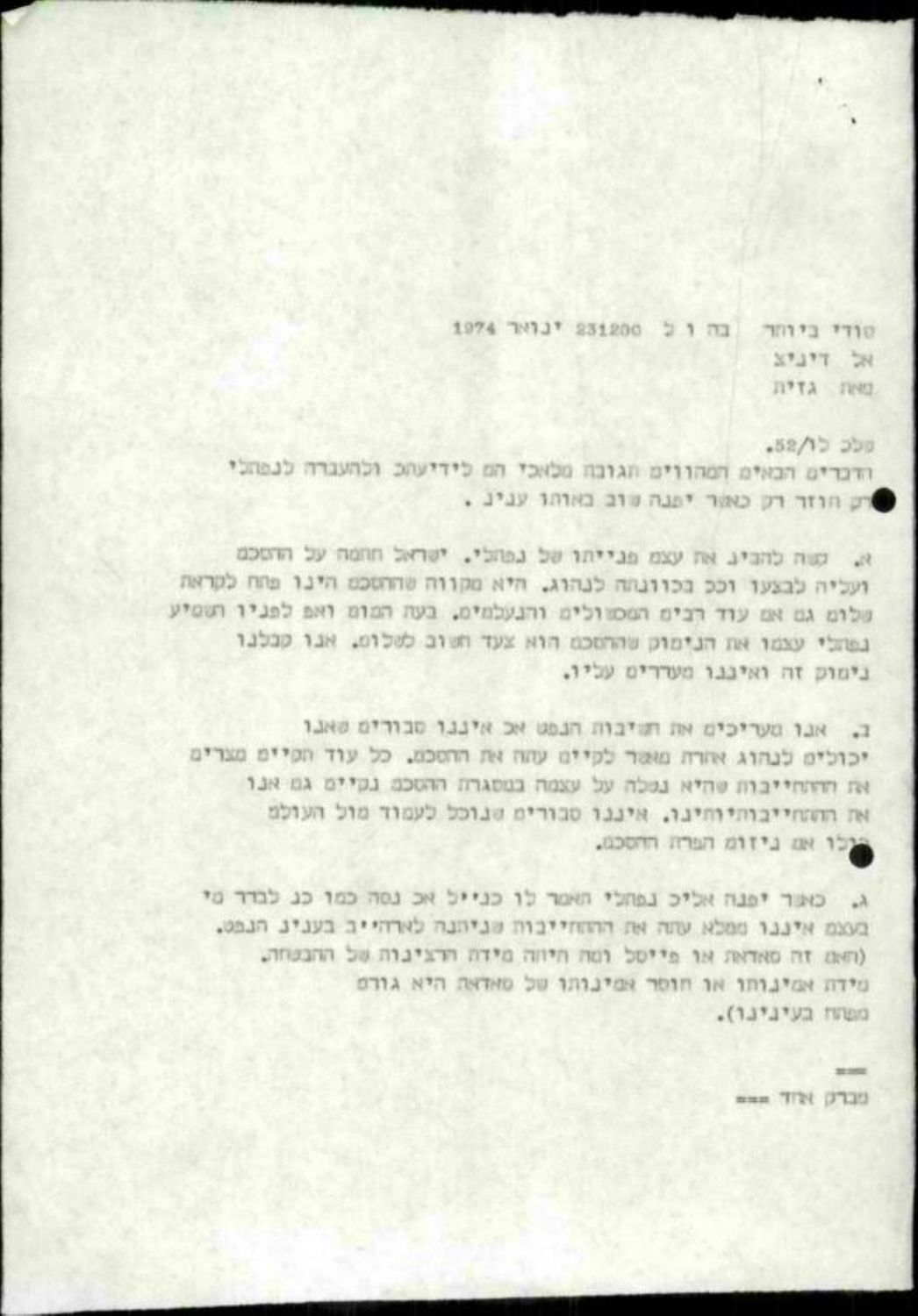
What the file shows, in the words on the page
21 January 1974
A wording he proposed by telephone
Three days after the disengagement agreement with Egypt was signed, Simcha DinitzIsrael’s ambassador in Washington from 1973.What they wanted: American arms and support, during the war and after it.More on Simcha Dinitz in “People and events” → came back to him about a public statement by the Prime Minister on arms supplies. “The wording you proposed in your telephone call, with the last words deleted, seems to me as follows”, he wrote, and then the sentence: “I have every reason to assume that the United States will continue to be alert to Israel’s security needs, in a positive and continuous approach” (site translation).
23 January 1974, 12:00
“Israel has signed the agreement and must carry it out”
An urgent cable, “To Simcha DinitzIsrael’s ambassador in Washington from 1973.What they wanted: American arms and support, during the war and after it.More on Simcha Dinitz in “People and events” →, from Gazit”.
It conveys what it calls “Malachi’s response”, a code name that by the context is the Prime Minister, to an approach by Henry KissingerU.S. National Security Adviser and Secretary of State.What they wanted: To push the Soviet Union out of the Middle East and make the United States the only broker, through step-by-step agreements.More on Henry Kissinger in “People and events” → that touched on oil and on carrying out the agreement: “It is hard to understand Naftali’s approach at all. Israel has signed the agreement and must carry it out, and so it intends to act. It hopes that the agreement is an opening towards peace, even if the obstacles and unknowns are still many.”
Kissinger himself, the cable says, had argued that the agreement was an important step towards peace: “We accepted that argument and we do not dispute it” (site translations).