
On the cover, by hand: “Personal material – Gazit”, “Nixon’s visit”. Richard Nixon came to Israel on 16 June 1974, two weeks after Yitzhak Rabin took office. The file holds the papers Gazit prepared for the visit, the ambassador’s cable sent to him alone, and the programme of the visit.
Two pages from the file
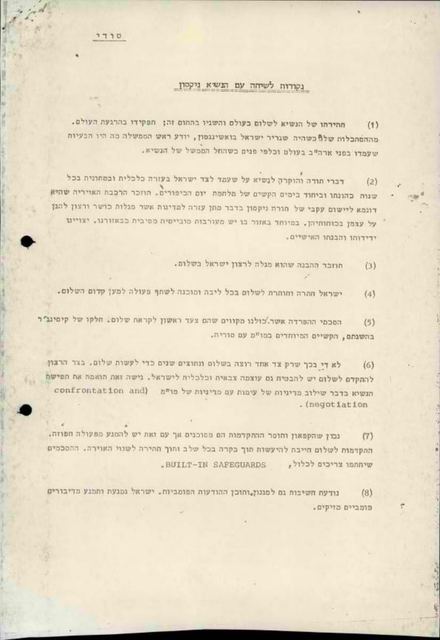
12 June 1974: “Points for the talk with President Nixon”, the first page 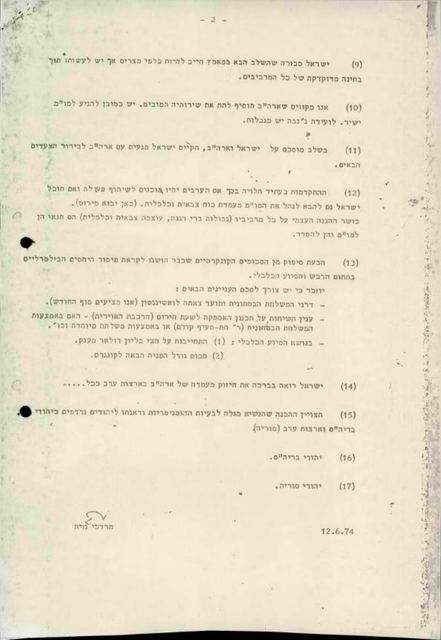
The second page, under his name: “Mordechai Gazit, 12.6.74”
Scans: Israel State Archives, file HZ-5973/11 ↗. Two pages of the file’s 114 are shown here; the file itself is kept at the Archives.
What the file shows, in the words on the page
8 June 1974
The question marks in brackets
An urgent cable from Ambassador Simcha DinitzIsrael’s ambassador in Washington from 1973.What they wanted: American arms and support, during the war and after it.More on Simcha Dinitz in “People and events” → was sent under the heading “To: Gazit, addressee only”. Gazit condensed it into two pages over his signature: what “Naftali”, that is Henry KissingerU.S. National Security Adviser and Secretary of State.What they wanted: To push the Soviet Union out of the Middle East and make the United States the only broker, through step-by-step agreements.More on Henry Kissinger in “People and events” →, had said the President needed. “A warm and impressive welcome. Thousands of people in the streets.”
And where the cable was unclear he added question marks of his own: “to award him a decoration (honorary citizenship of Jerusalem?)”, “in his car (Naftali’s? the President’s?) the Foreign Minister and Israel’s ambassador will ride” (site translations).
12 June 1974
Seventeen points for the talk
“Points for the talk with President Richard NixonPresident of the United States, 1969–1974.What they wanted: Stability in the Middle East and a check on Soviet influence, without a direct clash between the powers.More on Richard Nixon in “People and events” →”, marked secret, under his name and date. Seventeen points for what the Prime Minister would say. “It is not enough that only one side wants peace, and it takes two to make peace. Alongside the wish to move towards peace, military and economic strength must also be assured for Israel.”
“It is true that deadlock and lack of progress are dangerous, yet hasty action must be avoided.” And on direction: “Israel believes that the next stage of the effort must be towards Egypt, but it should be done with a meticulous examination of all the components” (site translations). The interim agreement with Egypt was signed fifteen months later.