
In the autumn of 1982 Gazit gave the oral-documentation section of the Davis Institute at the Hebrew University a file of papers he had chosen himself. The earliest is a seven-page paper he wrote in Washington in 1963, signed by hand. Most of the rest come from his years as ambassador in Paris. It also holds his own account of the battle of Qastal, from 1982.
Three pages from the file
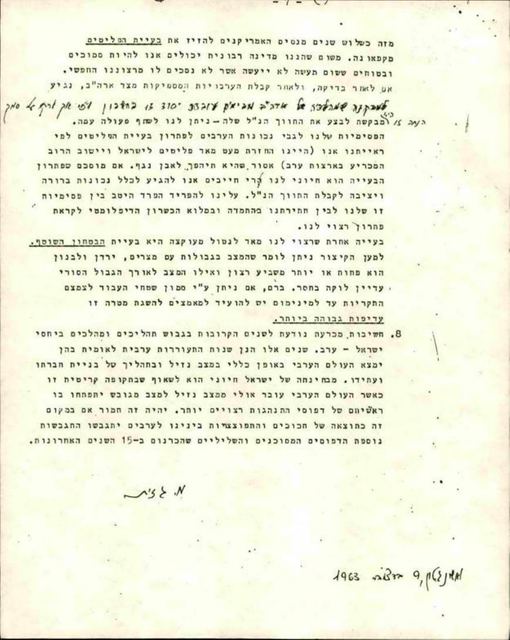
9 December 1963: the last page of the paper, signed “M. Gazit, Washington” 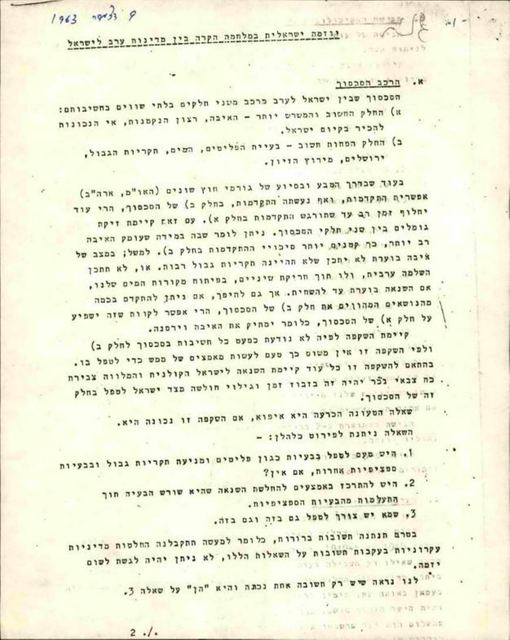
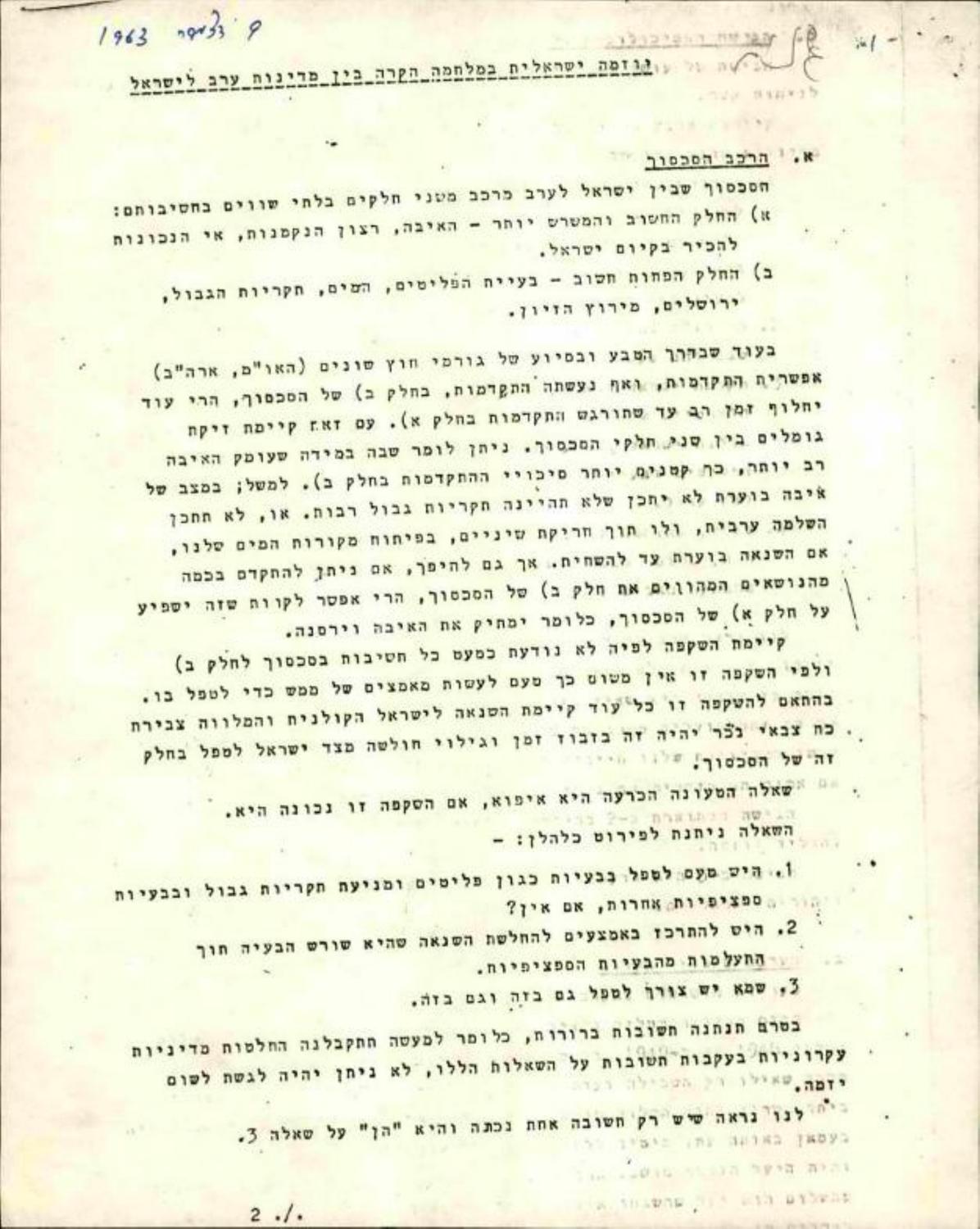
The first page: “An Israeli initiative in the cold war between the Arab states and Israel” 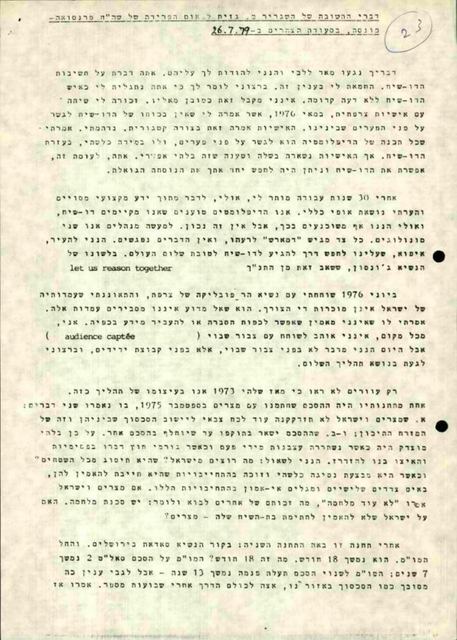
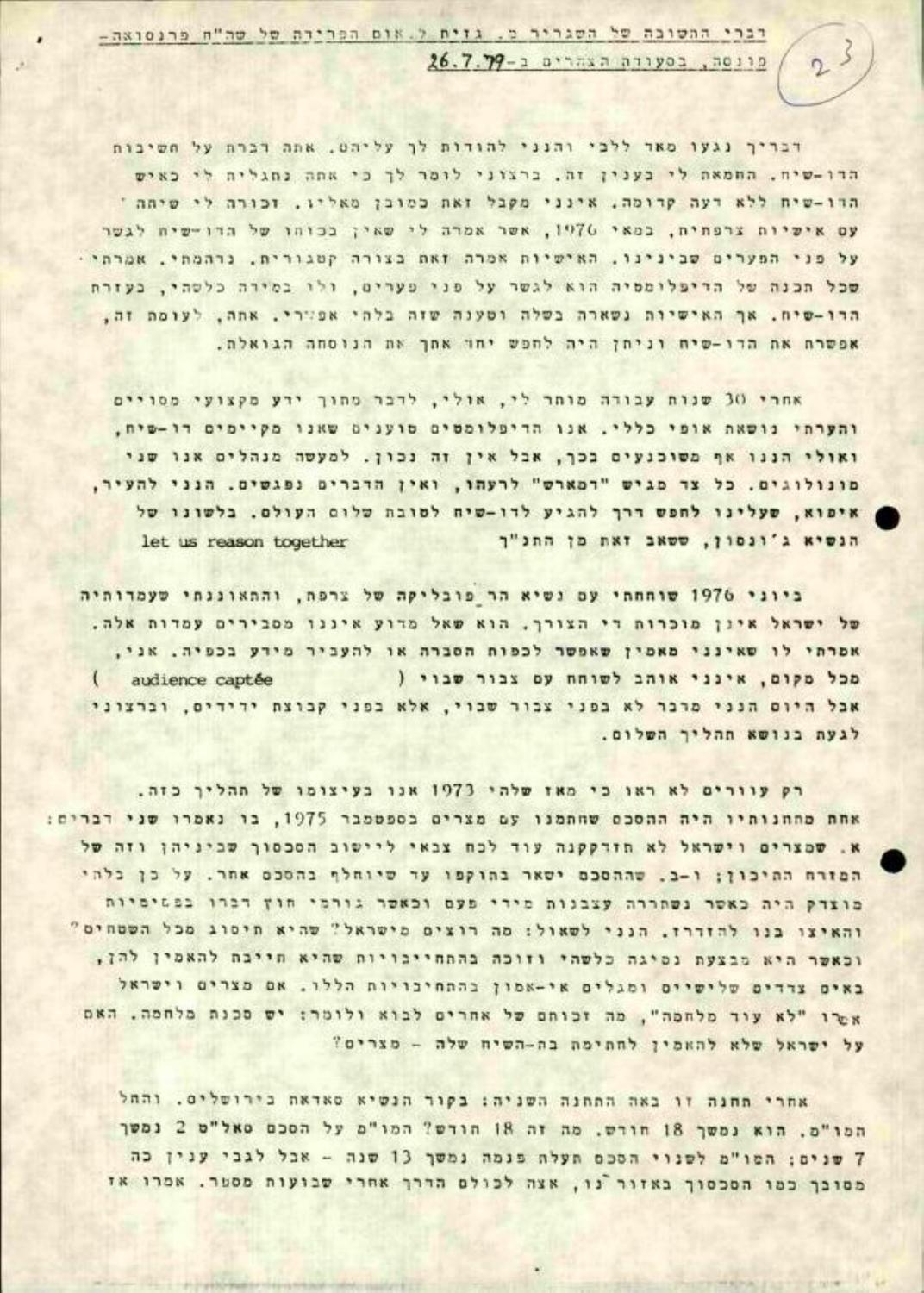
26 July 1979: his reply at the farewell luncheon in Paris
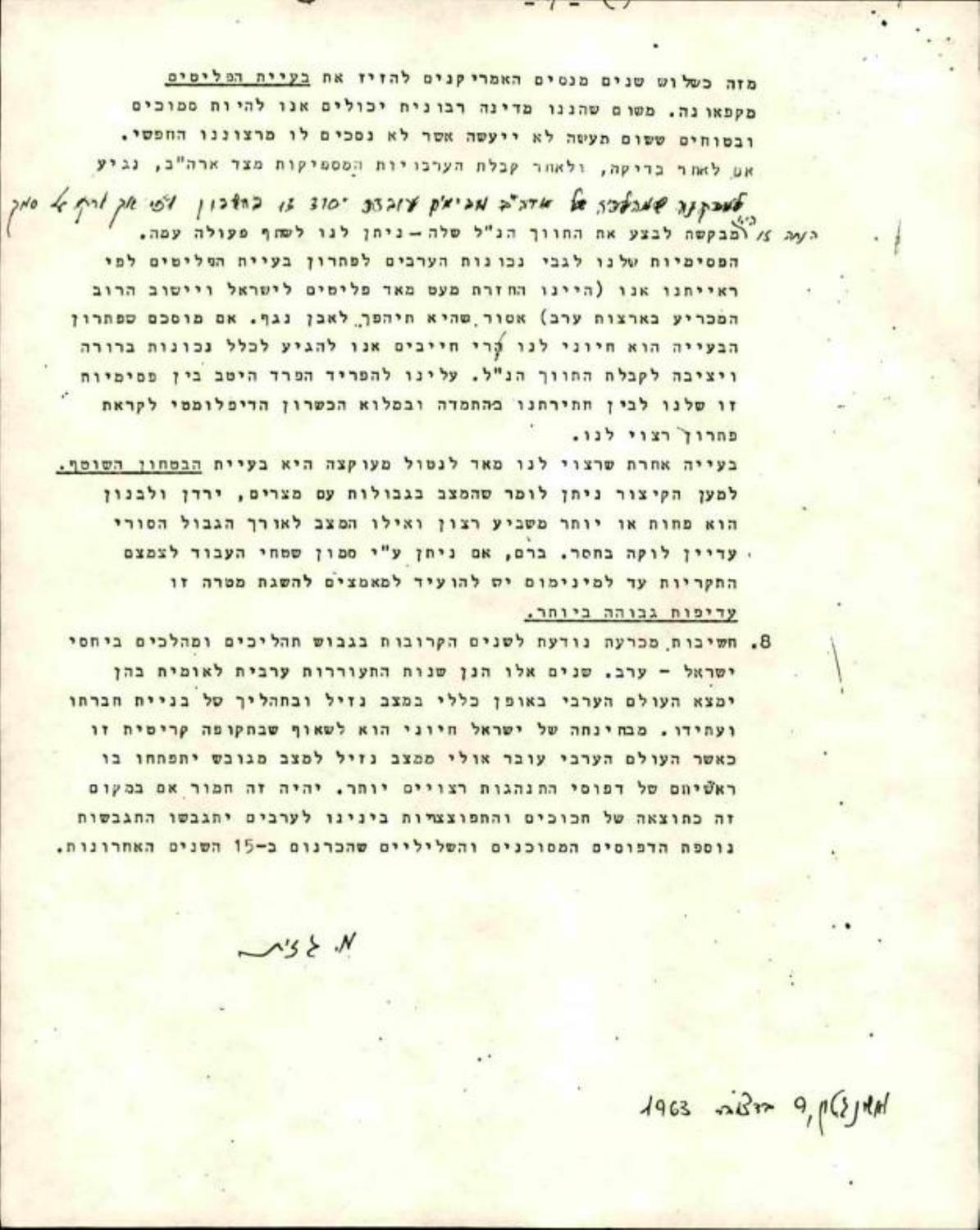
Scans: Israel State Archives, file A-7790/16 ↗. Three pages of the file’s 74 are shown here; the file itself is kept at the Archives.
What the file shows, in the words on the page
9 December 1963, Washington
“There is no short road to peace”
A seven-page paper, “An Israeli initiative in the cold war between the Arab states and Israel”, written when he was Minister at the embassy. At its end, in his hand: “M. Gazit”, “Washington, 9 December 1963”.
“There is no short road to peace with the Arabs”, he wrote; “the road to peace is long and is not strewn with roses; on the contrary, it is a road of suffering, and yet a road to peace exists.” And straight after: “Israel must likewise wean itself from the search for miracle cures for peace.”
The thought “that Israel itself has the power to impose peace” he called “the most dangerous of the thoughts” (site translations). The page names no addressee, and the file holds no reply to the paper.
9 December 1963, Washington
The fear on both sides
In the same paper he wrote of what Israel, as he put it, does not want to admit: “for all its two brilliant victories it is gripped by fear of Arab military capability, at least of the potential one.”
And at once he turned the view around: “the Arab fear of Israel is seven times greater than Israel’s fear of the Arabs” (site translations). From this he concluded that wide publicity around arms procurement harms anyone who seeks initiatives towards the Arab world.
9 December 1963, Washington
Eight proposals, and a sentence of Kennedy’s
The paper ends with eight lines of action, among them contacts with Arab students and public figures, information in Arabic, and “to set up a television service a good part of whose programmes would be directed at the Arab countries”.
On mediation he wrote: “Fear of negotiation (even direct and through a mediator) means paralysis” (site translations), and cited “the words of the late John F. KennedyPresident of the United States, 1961–1963. Gazit wrote a book on his policy.What they wanted: To prevent the spread of nuclear weapons, including at Dimona, and to build ties with the Arab states as well.More on John F. Kennedy in “People and events” →”, in English: “Let us never negotiate out [of] fear but let us never fear to negotiate”. President Kennedy had been assassinated seventeen days earlier.
18 October 1976, Paris
How Paris saw him
A signed letter from Jean de LipkowskiA French Gaullist politician; served as a secretary of state at the Foreign Ministry, and later as a minister.More on Jean de Lipkowski in “People and events” →, on the letterhead of the French Foreign Ministry, to “Monsieur l’Ambassadeur et cher Ami”, less than a year after he arrived in Paris: “Vous savez défendre votre dossier avec une intelligence, une finesse dans l’analyse, une sureté dans la dialectique mais aussi avec un tact, une psychologie et une honnêteté intellectuelle impressionnantes. Vous vous êtes déjà imposé en France comme un grand Ambassadeur digne du grand pays qui est le vôtre.”
26 July 1979, Paris
“Two monologues”, and “50 per cent, not 51”
A record of his reply to the farewell speech of Foreign Minister Jean François-PoncetForeign Minister of France, 1978–1981.More on Jean François-Poncet in “People and events” →, at the luncheon of 26 July 1979. “After 30 years of work I may, perhaps, speak from a certain professional knowledge”, he said, according to the record.
“We diplomats claim that we conduct a dialogue, and perhaps we are even convinced of it, but it is not so. In fact we conduct two monologues.”
And on Israel’s share: it “holds in its hands 50 per cent of the keys to the door of peace. I stress: 50 per cent, and not 51 per cent. We should not be charged with responsibility beyond that which we bear” (site translations).
8 October 1982
Looking back on Paris
A five-page paper under his name: “France–Israel relations in the years 1975–1979, during my term as ambassador in Paris”. It ends with “a personal note”: “In December 1975, when I left for Paris, the heads of our state had no hopes whatever of an improvement in relations with France. Even preventing a further deterioration seemed a goal hard to reach.”
And the conclusion, measured: “We do not claim that an important turn took place in France–Israel relations, but we have sought to point to a slight improvement that occurred in January 1977, and to the fact that the French government has kept to it ever since” (site translations).
June 1982
Qastal, in his own words: “It happened ten metres from me”
In 1982 Dr Uri MilsteinMilitary historian; interviewed Gazit about the battle of Qastal in 1982.More on Uri Milstein in “People and events” → interviewed him about the battle of Qastal, of April 1948. Gazit corrected the transcript in his own hand, answered the interviewer’s questions in a signed letter, and in September handed the material to the Institute, writing that there was no restriction on the use of his letter and of what had been recorded from him.
Of his post he said: “I was the commander of the reserve company of the whole district of the Jerusalem Brigade. It was quartered at Schneller.” Of the death of Abd al-Qadir al-HusayniCommander of the “Holy War” forces in the Jerusalem area; killed at Qastal in April 1948.More on Abd al-Qadir al-Husayni in “People and events” →, on the morning of 8 April: “The one who killed him was the company sergeant-major, the late Meir Karmiol. It happened ten metres from me.”
The words “the company sergeant-major” and “the late” were added by hand, among the corrections to the transcript.
And of the retreat from the village: “I gave the order to get everyone out, and we began to fall back in bounds. We woke everyone, we got the wounded out. […] I myself dragged and rolled a man wounded in the ankle. He survived.”
In the letter, written in his own hand, he recalled that when he reached Arza and was asked what would happen now, he answered that it was better not to ask him: he was in the shock of the retreat, and his answer would reflect it (site translations).