
Historical context and questions to explore
Washington, early November 1973. Golda Meir arrives about a week after the ceasefire, and the situation in the south is strange: the Egyptian Third Army is encircled, and hundreds of Israeli prisoners are held by Egypt and Syria. Who will release whom, and at what price?
The United States wanted to stabilise the ceasefire, ease the oil pressure on the world and build standing in Cairo. Israel wanted its prisoners back and the naval blockade that Egypt had imposed at the mouth of the Red Sea lifted. On 11 November the six-point agreement was signed, on keeping the ceasefire, supplies to the encircled army and an exchange of prisoners. It was signed at Kilometre 101 on the Cairo–Suez road, where officers of the two armies met.
Why it mattered. This was Golda Meir’s first meeting with President Nixon after the war, and it set the direction for the direct talks between Israeli and Egyptian officers, the first since 1949.
A question to think about
How do you turn what was won in the field into a political settlement, without losing the American support the country leaned on?
Why it was hard. Where the “22 October line” ran, the line the forces held when the ceasefire took effect, was an open question. Supplies to the encircled army were a bargaining card, but also a humanitarian and political issue the world was watching.
His part: In November 1973 Gazit sat beside Golda Meir in the Washington talks and in the Oval Office, kept the record, and proposed to Kissinger a practical formula for the exchange of prisoners.
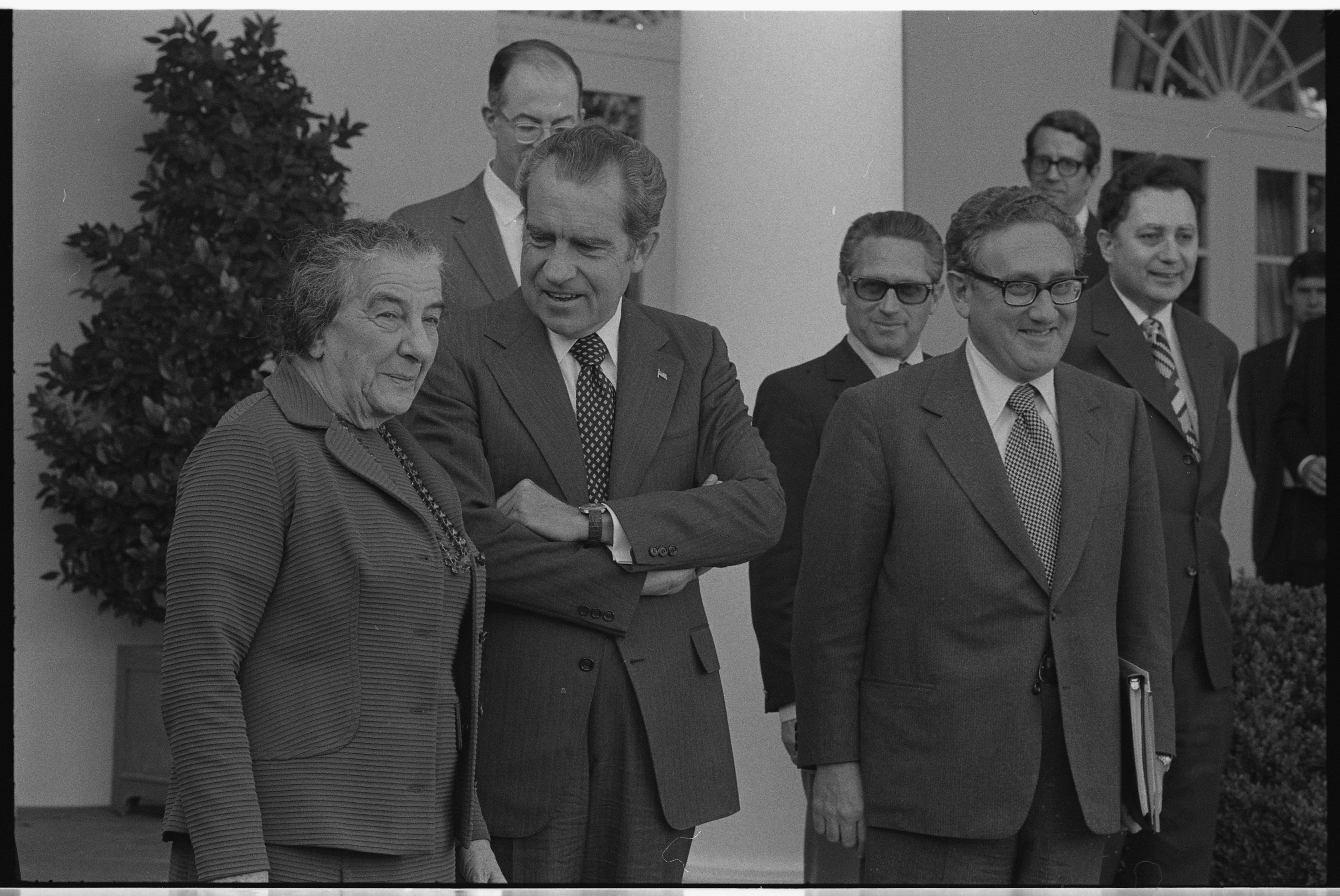
After the war, Gazit travelled to Washington with Golda MeirPrime Minister, 1969–1974. Gazit headed her office twice: when she was Foreign Minister in the late 1950s, and as Director-General of the Prime Minister’s Office from 1973.What they wanted: Security for Israel, and peace through direct negotiation, without a return to the 1967 lines.More on Golda Meir in “People and events” → and sat beside her in the talks at the White House. The discussion concerned supplies for Egyptian forces, military lines and the possibility of moving towards an agreement. He suggested emphasizing direct talks between the generals, considered alternative wording for redeployment and raised the issue of the wounded.
The same day, Gazit went into the Oval Office with Golda Meir, Ambassador Simcha DinitzIsrael’s ambassador in Washington from 1973.What they wanted: American arms and support, during the war and after it.More on Simcha Dinitz in “People and events” → and General Aharon YarivMajor General, former head of Military Intelligence and adviser to the Prime Minister.What they wanted: To use the ceasefire for direct military talks with Egypt, at Kilometre 101.More on Aharon Yariv in “People and events” → for a meeting with President Richard NixonPresident of the United States, 1969–1974.What they wanted: Stability in the Middle East and a check on Soviet influence, without a direct clash between the powers.More on Richard Nixon in “People and events” → and Henry KissingerU.S. National Security Adviser and Secretary of State.What they wanted: To push the Soviet Union out of the Middle East and make the United States the only broker, through step-by-step agreements.More on Henry Kissinger in “People and events” →. Meir thanked the President for the airlift, the transport planes that flew arms and ammunition to Israel during the war, and spoke of the prisoners and of the war’s toll.
Nixon described the decisions he had taken during the war and urged her to make the most of the direct talks that had opened between the generals. At the end, the President walked the Prime Minister to the Rose Garden steps for photographs.
The next day, 2 November, the talks with Kissinger ran past midnight at Blair House. The argument turned on the Israeli prisoners in Egypt: Kissinger asked Israel to agree in principle to return to the October 22 lines, and Golda Meir refused to allow convoys to the Third Army without the prisoners coming home. Gazit looked for a practical way through.
“Could you promise dates and procedures for a negotiation?” he asked. Later he suggested that Kissinger leave Cairo with an announcement that the negotiations would begin on 15 December — “with an announcement that the prisoners will be exchanged on that date.” “It would be a great announcement,” Kissinger replied.
The IDF Archives (file 14–58/79) hold Gazit’s Hebrew records of the 1 November meetings, with Nixon and with Kissinger, and of the meetings with Kissinger on 2 and 3 November, as well as a document of “conclusions” he wrote on the visit on 5 November. The meeting of 4 November was recorded by Mordechai ShalevMinister at the Israeli embassy in Washington.More on Mordechai Shalev in “People and events” →.
According to the historian Alec EpsteinA historian; wrote on Israel’s relations with Egypt.More on Alec Epstein in “People and events” →, drawing on the conclusions document, Kissinger then explained turning down requests for arms to rebuild the force after the war by the crisis of trust around Nixon over Watergate, the scandal that finally led to his resignation.
The records are also kept in a Foreign Ministry file at the State Archives (HZ-5973/5), read here in full. The Hebrew record of the meeting with Nixon, fourteen pages long, ends with his handwritten signature.
The file also holds a four-page analysis he wrote on 5 November, as the visit ended: “The Prime Minister’s visit to the United States (points for a summary)”.
“The weakness of the United States has two causes”, he wrote: “the terrible weakness of the presidency and the total crisis of confidence that marks relations between the President and the people”, and the shortage of vital military items.
Beneath his signature he added: “This analysis was written in haste and with no chance to check with other colleagues whether it seems right to them” (site translations).Diplomatic recordThe Washington Talks, 1 November 1973Diplomatic recordFRUS — Golda Meir with President Nixon, November 1973Diplomatic recordFRUS — At Blair House, 2 November 1973Book or articleAlec Epstein — Israel and Egypt: Half a Century without War (Russian)Diplomatic recordState Archives — file HZ-5973/5: Mordechai Gazit, the Prime Minister’s talks in Washington, November 1973 (Hebrew)
Sources and reading notes (5)
The lead source
FRUS — At Blair House, 2 November 1973 ↗FRUS, vol. XXV, doc. 312. Golda Meir and her team with Kissinger on the prisoners and the October 22 lines; Gazit’s questions and proposals.
- Diplomatic Records[ISA59735] State Archives — file HZ-5973/5: Mordechai Gazit, the Prime Minister’s talks in Washington, November 1973 (Hebrew) ↗
A Foreign Ministry file, 114 scanned pages, read in full for this site. It holds the Hebrew records of Golda Meir’s talks with President Nixon and with Kissinger in the first days of November 1973, the record of the Nixon meeting signed by Gazit, and his four-page signed analysis of 5 November 1973, “The Prime Minister’s visit to the United States (points for a summary)”. One memorandum of 2 November 1973 was withdrawn from the file.
- Diplomatic Records[D2] The Washington Talks, 1 November 1973 ↗
FRUS, Volume XXV, Document 305. Gazit participates in a discussion of direct talks, redeployment and prisoners of war.
- Diplomatic Records[FR73N] FRUS — Golda Meir with President Nixon, November 1973 ↗
FRUS, Volume XXV, Document 306. The Oval Office. Gazit at the meeting, as Director-General of the Prime Minister’s Office.
- Diplomatic Records[FR73B] FRUS — At Blair House, 2 November 1973 ↗
FRUS, vol. XXV, doc. 312. Golda Meir and her team with Kissinger on the prisoners and the October 22 lines; Gazit’s questions and proposals.
- Books, Articles and Letters[EPS22] Alec Epstein — Israel and Egypt: Half a Century without War (Russian) ↗
Institute of Middle Eastern Studies, Moscow, 2022. pp. 28–33: Gazit’s records of the meetings of 1–3 November 1973 and his “conclusions” of 5 November, IDF Archives, file 14–58/79 (the meeting of 4 November was recorded by Mordechai Shalev); the Watergate point on p. 32; and the Vienna meeting of 22–26 March 1973, per Primakov’s memoirs (2012 edition, pp. 286–287).