
After the Palmach, the Haganah’s full-time strike force, took al-Qastal on 3 April 1948, a company of the Etzioni Brigade’s Moriah Battalion held the village under Gazit’s command. During a lull in the fighting, one of his sentries shot and killed an Arab fighter. No one knew then who he was.
The next morning the Haganah intelligence service in Jerusalem called to ask about him, and only then did Gazit realise that the dead man was Abd al-Qadir al-HusayniCommander of the “Holy War” forces in the Jerusalem area; killed at Qastal in April 1948.More on Abd al-Qadir al-Husayni in “People and events” →, commander of the “Holy War” forces in the Jerusalem area. Gazit examined the body himself and took his papers.
Asked to send the body to the city, he refused: the Arabs were sniping, and his men had not slept for five nights. The Arab commander’s death was a severe blow to his fighters’ morale. Gazit led the exhausted defenders and asked for them to be relieved; they withdrew on 8 April.
Two days later he wrote to his parents, in English: “I am just back from the Castel where I personally had the honour to throw a hand granate at Abdul Kader Husseini.”
In his own hand · 10 April 1948
A letter to his parents, 10 April 1948
Two days after his men withdrew from Qastal, Gazit wrote his parents a few lines, in English. The letter, one page in his own hand, is given here in full.
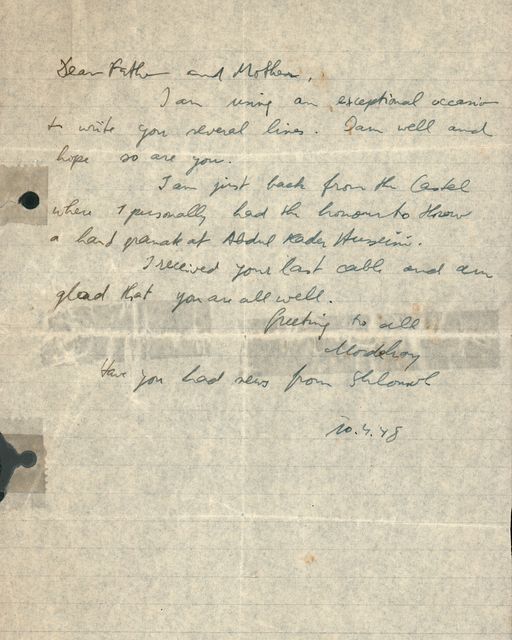
The letter of 10 April 1948
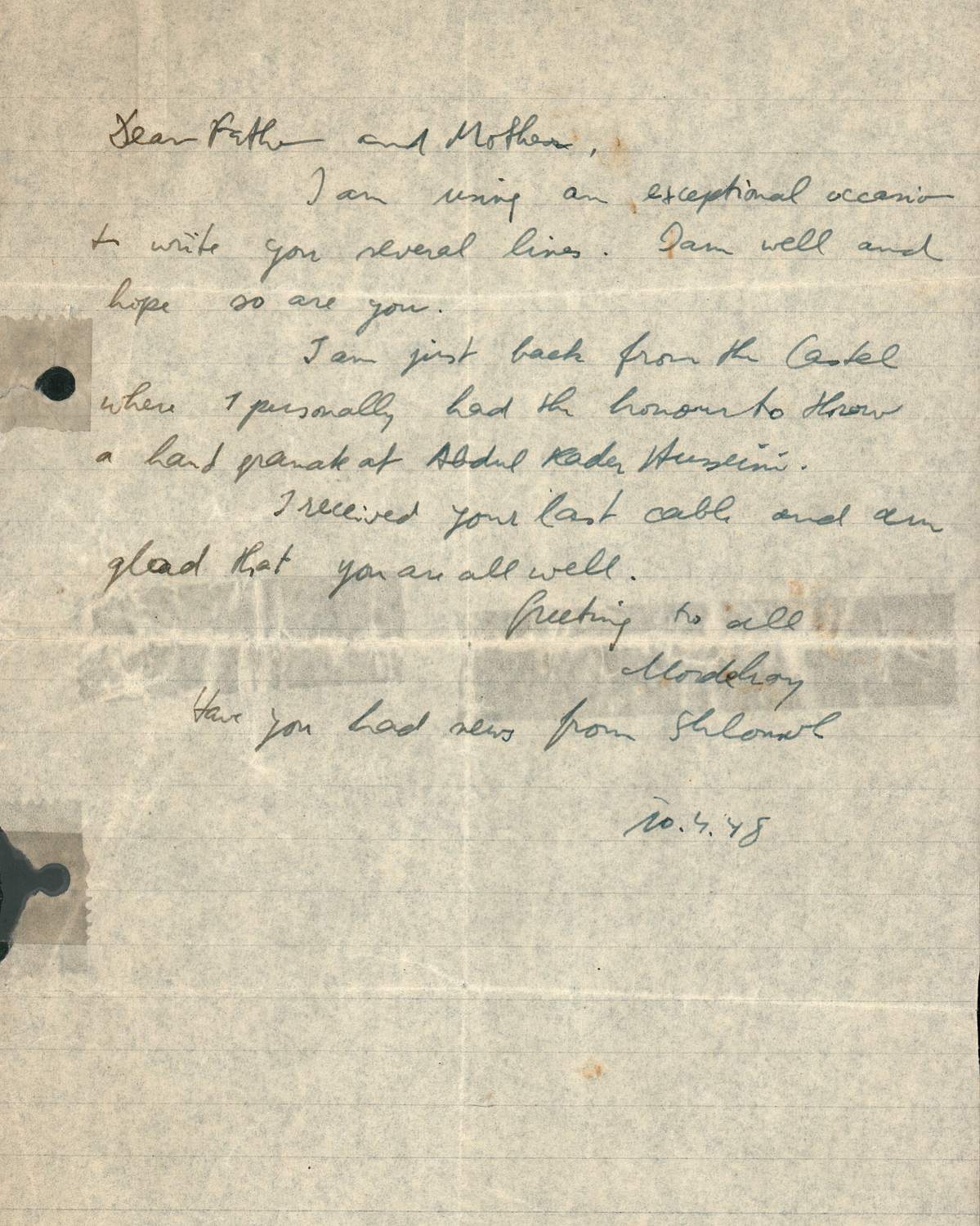
Dear Father and Mother,
I am using an exceptional occasion to write you several lines. I am well and hope so are you.
I am just back from the Castel where I personally had the honour to throw a hand granate at Abdul Kader Husseini.
I received your last cable and am glad that you are all well.
Greeting to allMordehayHave you had news from Shlomo?10.4.48
Transcribed by the site from the scan. His spelling is kept; words he crossed out are left out, and square brackets mark letters the site completed.
What the letter says, and what it does not
- This is his own account, in his own hand, two days after the event: Abd al-Qadir al-Husayni was killed at Qastal on 8 April 1948.
- The letter does not describe what happened, and does not say what came of the grenade. In the account given at this station, he was shot by a sentry of Gazit’s company.
- Thirty-four years later, in an interview he corrected in his own hand, Gazit himself said: “The one who killed him was the company sergeant-major, the late Meir Karmiol. It happened ten metres from me” (site translation). The interview is kept at the State Archives, in the file he deposited at the Davis Institute. His account of 1982
- “An exceptional occasion”: Jerusalem was then under siege.
- At the foot of the letter he asks after Shlomo. Shlomo is his younger brother.
- Why in English? The family’s guess is that his parents, Tzipora and Ephraim, found Hebrew hard to read: both knew many languages, but the Hebrew letters, it seems, less well.
Credit
Mordechai Gazit Archive (Truman Institute)The Digital Archives for Middle Eastern Studies and Israel StudiesThe Library AuthorityThe Hebrew University of Jerusalem
The archive’s record in the library catalogue ↗A fork in the road
One hill, and a whole city hanging on it.
Hold at any cost
The price: A few exhausted fighters against a growing force.
Pull back
The price: The road to besieged Jerusalem closes again.
And what happened?
They held for a few days, until they were relieved on 8 April. The road opened for a short time.
Sources (5)
Israel and the world
The struggle for the road to Jerusalem
The fighting at Qastal formed part of Operation Nachshon and the effort to bring supplies into Jerusalem. Control of the hill overlooking the road changed during the battles; its recapture helped reopen the route temporarily.
Explore on Wikipedia