
On the night of 18–19 May 1948, a force of the Palmach, the Haganah’s mobilised strike force, broke through Zion Gate, and behind it a relief force of about 80 men, loaded with military and medical supplies, entered the Jewish Quarter under Gazit’s command. It had been gathered from different units in the city: students, Haganah field troops, veterans and checkpoint guards.
The Palmach commanders asked Gazit’s men to take their place in the Quarter so that the Palmach could withdraw. Gazit objected: he had been ordered to hold Mount Zion, and his men had not been trained for the kind of fighting the Quarter demanded. By order of the Jerusalem district commander he was made commander of the Quarter.
At dawn he went out to inspect the positions and was severely wounded by shots fired at him. Until the Quarter fell nine days later, he lay wounded in the Misgav Ladach hospital; some of his men fought to the end and went into Jordanian captivity.
When the Quarter surrendered, on 28 May, to the Arab Legion’s commander in the Old City, Abdullah el-Tell, the men of military age were taken prisoner. The seriously wounded were handed to the Red Cross and moved to Jewish Jerusalem. A month after he was wounded, on 19 June, he wrote to his parents from Bikur Holim Hospital, in English.
He told them he was engaged to Rina, and only at the end added: “I forgot to tell you that I was wounded in the chest (lung)”. The injury ended his combat service and cost him a lung. In a 1980 interview he said it “gave me further impetus to go on in government.”
Yitzhak RabinPrime Minister, 1974–1977; earlier Deputy Chief of Staff and ambassador in Washington.What they wanted: To move step by step, through interim agreements, in return for American guarantees and arms.More on Yitzhak Rabin in “People and events” →, who commanded the Palmach’s Harel Brigade at the time, also came back to that night years later: of the force gathered to enter the Old City, he said in an interview, “Mordechai Gazit … was put in command.”
In his own hand · 19 June 1948
A letter to his parents, 19 June 1948
A month after he was wounded, Gazit wrote to his parents from hospital, in English. They had already heard of the wound from someone else, and not accurately. The letter, two pages in his own hand, is given here in full.
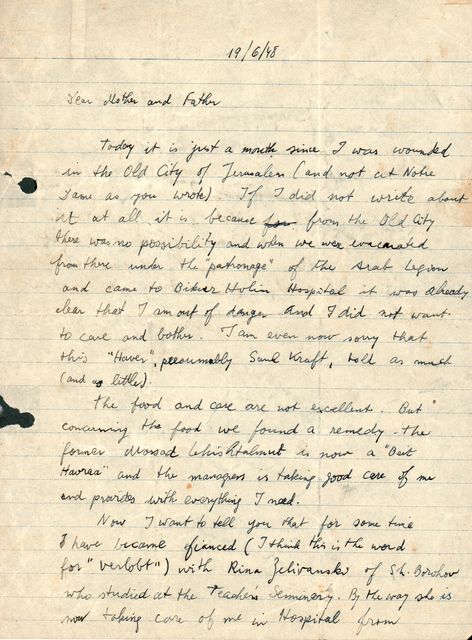
The first page 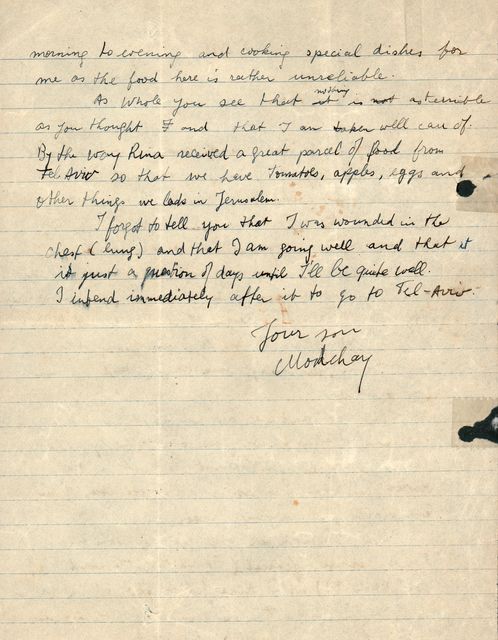
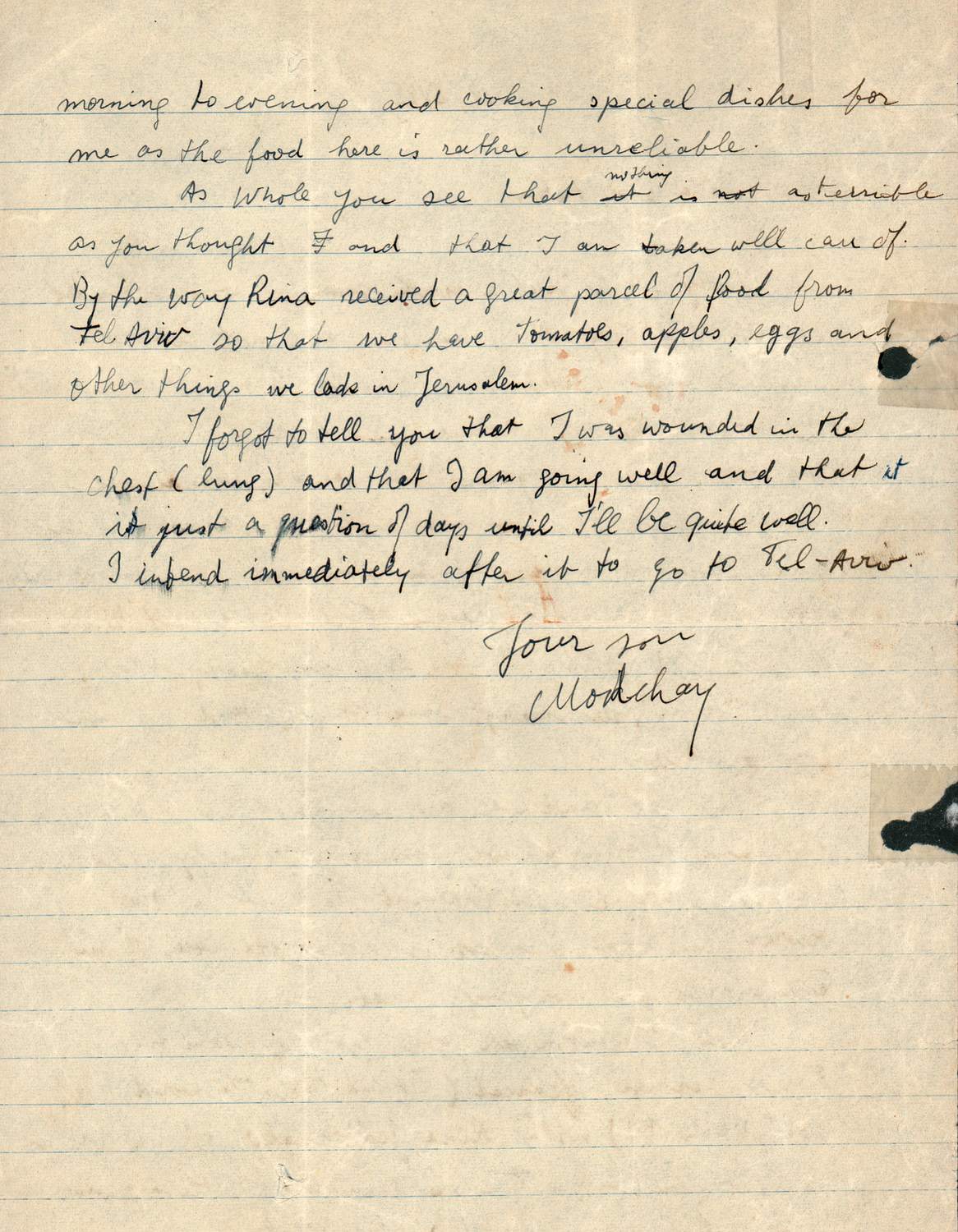
The second page, and the signature
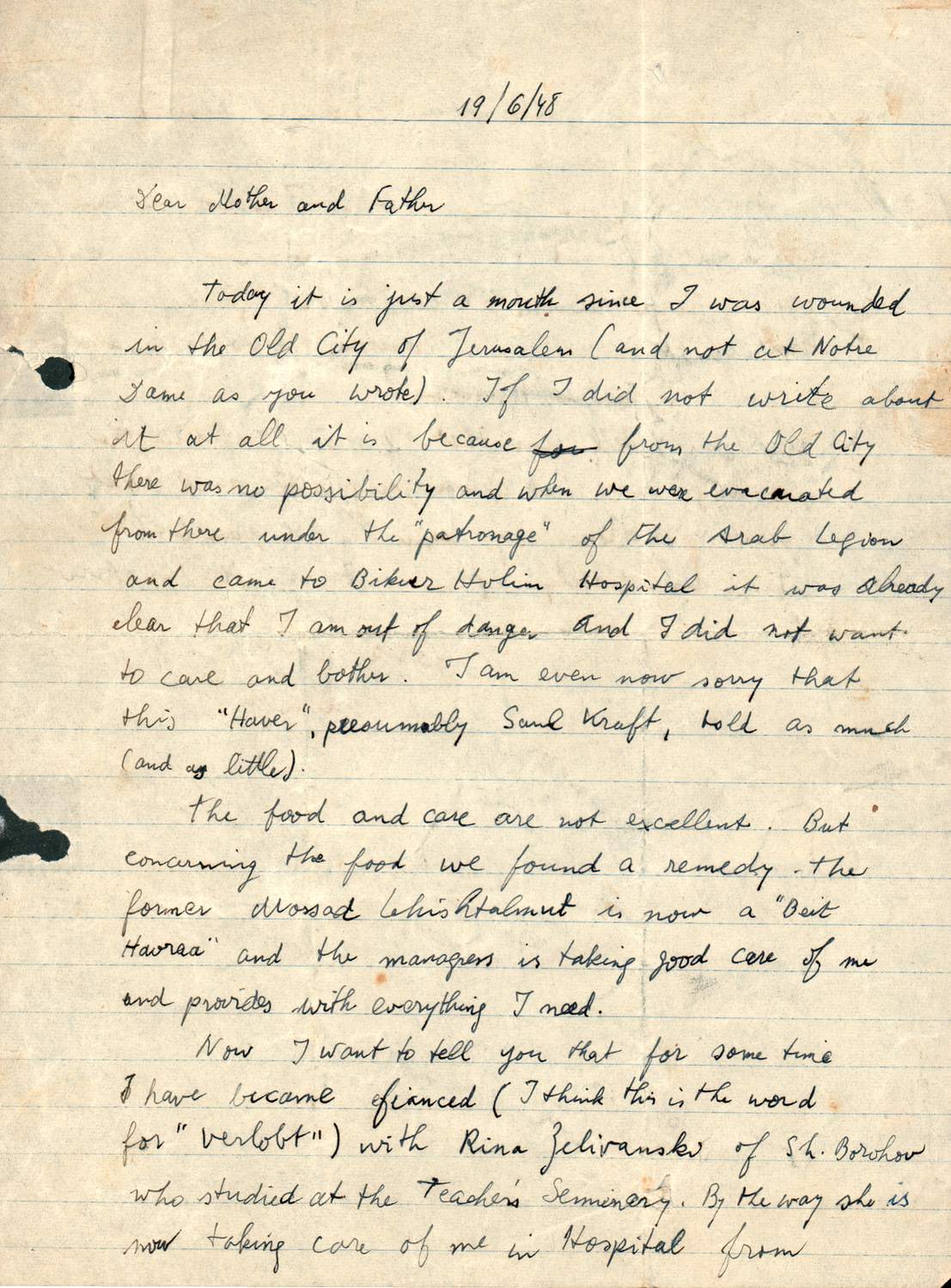
Dear Mother and Father
Today it is just a month since I was wounded in the Old City of Jerusalem (and not at Notre Dame as you wrote). If I did not write about it at all it is because from the Old City there was no possibility and when we were evacuated from there under the “patronage” of the Arab Legion and came to Bikur Holim Hospital it was already clear that I am out of danger. And I did not want to care and bother. I am even now sorry that this “Haver”, presumably Saul Kraft, told as much (and as little).
The food and care are not excellent. But concerning the food we found a remedy - the former Mossad Lehishtalmut is now a “Beit Havraa” and the manager[es]s is taking good care of me and provides with everything I need.
Now I want to tell you that for some time I have become efianced (I think this is the word for “verlobt”) with Rina Zelivansky of Sh. Borohov who studied at the Teacher’s Seminary. By the way she is now taking care of me in Hospital from morning to evening and cooking special dishes for me as the food here is rather unreliable.
As whole you see that nothing is as terrible as you thought and that I am well cared of. By the way Rina received a great parcel of food from Tel Aviv so that we have tomatoes, apples, eggs and other things we lack in Jerusalem.
I forgot to tell you that I was wounded in the chest (lung) and that I am going well and that it is just a question of days until I’ll be quite well. I intend immediately after it to go to Tel-Aviv.
Your sonMordechay
Transcribed by the site from the scan. His spelling is kept; words he crossed out are left out, and square brackets mark letters the site completed.
What the letter says, and what it does not
- The date: “today it is just a month” since the wound, which gives 19 May 1948. In the account given at this station, too, he was wounded at dawn that day.
- The rumour: his parents had been told he was wounded at Notre Dame. He corrects it: in the Old City.
- The evacuation: under the “patronage” of the Arab Legion, and the quotation marks are his. From there he came to Bikur Holim Hospital.
- The wound itself, in the chest and the lung, comes only at the end, after the food and the engagement: “I forgot to tell you”.
- Rina: he announces that they have been engaged “for some time”, and that she is at his side in hospital from morning to evening. The letter gives no date for the engagement. He spells her family name Zelivansky; the family writes it Zalbansky (זלבנסקי).
- “Mossad Lehishtalmut” is the name of the Jewish Agency’s school for diplomats, where he studied until the spring of 1948.
- The German word verlobt, engaged: German was spoken in his parents’ home, as his brother Shlomo later recalled.
- Why in English? The family’s guess is that his parents, Tzipora and Ephraim, found Hebrew hard to read: both knew many languages, but the Hebrew letters, it seems, less well.
Credit
Mordechai Gazit Archive (Truman Institute)The Digital Archives for Middle Eastern Studies and Israel StudiesThe Library AuthorityThe Hebrew University of Jerusalem
The archive’s record in the library catalogue ↗A fork in the road
Break into the besieged Quarter now, with a small, improvised force?
Break in tonight
The price: Some 80 men gathered from wherever they could be found, without preparation.
Wait for a larger force
The price: The Quarter might fall before it arrived.
And what happened?
They broke in on the night of 18–19 May. Gazit was badly wounded, and the Quarter fell on 28 May.
Sources (9)
- Yehuda Lapidot — The Battle for the Old City Biography
- Rami Yizre’el — The Jewish Quarter in the war Biography
- Haganah Heritage — Zion Gate (Hebrew) Biography
- The Jewish Quarter in the War of Independence (Hebrew) Biography
- Mordechai Gazit — Hebrew Wikipedia Biography
- Daniel S. Benjamin — Mordechai Gazit Returns to Academe Testimony
- FRUS 1948, Volume V, Part 2, Document 345 Diplomatic record
- Interview with Yitzhak Rabin on the 1948 fighting in Jerusalem (transcript “Strap 32”) Diplomatic record
- Mordechai Gazit Archive (Truman Institute) — two letters to his parents, 1948 Biography
Israel and the world
Jerusalem in the 1948 war
Jerusalem and its supply routes were a central theatre of the war. The fighting left the city divided: West Jerusalem under Israeli control, and East Jerusalem and the Old City under Jordanian control.
Explore on WikipediaTwo accounts of the injury
Yehuda Lapidot describes an injury during a dawn inspection after Gazit assumed command. Rami Yizre’el gives the afternoon and says he could not assume command as planned. The discrepancy remains unresolved.